
Gold IRA Storage Options: Segregated, Commingled, and Home Storage
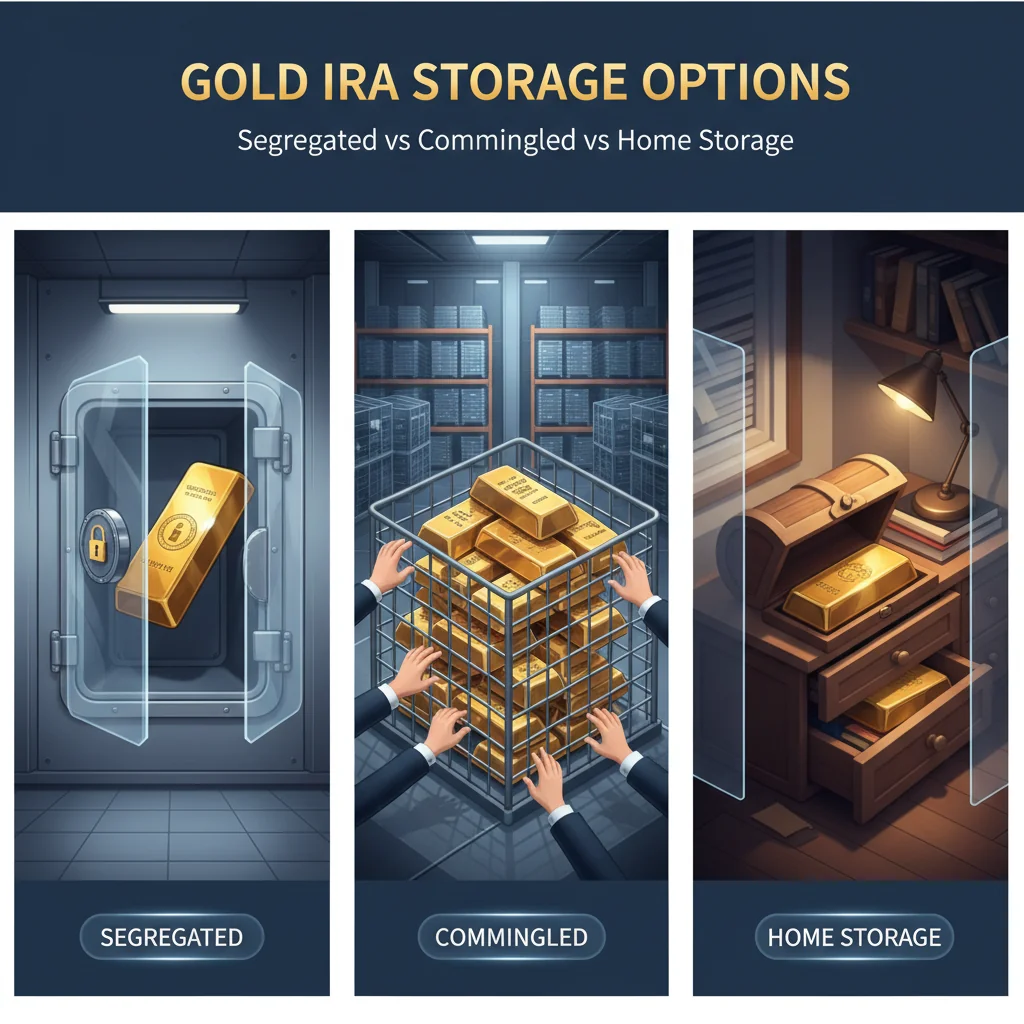
Editor's note: Names, images, and identifying details have been changed to protect the privacy of individuals featured in this article.
Disclaimer: This article is for informational and educational purposes only and does not constitute financial, investment, or tax advice. Always consult a qualified financial advisor, tax professional, or investment professional before making investment decisions.
Turning 50 felt like a deadline for Matthew, a successful small business owner in Phoenix, AZ. With a robust emergency fund, a diversified portfolio, and a comfortable six-figure income, Matthew was financially stable. However, he was looking for ways to further diversify his retirement savings and hedge against inflation, and a Gold IRA had caught his attention. The complexities of storing physical gold, especially the jargon like "segregated" and "commingled" storage, left him feeling overwhelmed. This article will demystify the various Gold IRA storage options, helping you understand the critical differences, regulations, and implications for your retirement savings, ensuring you can make an informed decision just like Matthew needed to.
Gold IRA Storage Options Definition: Gold IRA storage refers to the methods approved by the IRS for holding the physical precious metals within a self-directed Individual Retirement Account (IRA), primarily categorized as segregated, commingled, or, in very limited and generally unadvised circumstances, home storage.
Understanding IRS Regulations for Gold IRA Storage
When considering a Gold IRA, the first and most crucial aspect to grasp is the stringent regulations set forth by the Internal Revenue Service (IRS). Unlike traditional paper assets like stocks or mutual funds, a Gold IRA involves physical precious metals, which must be stored in a very specific manner to maintain the account's tax-advantaged status. The IRS does not permit individuals to personally hold the physical gold, silver, platinum, or palladium that backs their IRA. This rule is designed to prevent self-dealing and ensure the integrity of retirement accounts, and home storage for a Gold IRA is almost universally non-compliant and carries severe tax penalties. The 'no personal possession' rule is fundamental for maintaining tax-advantaged status.
The core principle is that the assets must be held by a third-party custodian and stored in an approved depository. This separation of ownership and physical possession is fundamental to all compliant Gold IRAs. Failure to adhere to these IRS guidelines can result in severe penalties, including the potential reclassification of your IRA as a taxable distribution, along with applicable taxes and penalties. Understanding these foundational rules is the first step in navigating the various storage options available for your precious metals.
The Role of an Approved Custodian and Depository
For a Gold IRA to be IRS-compliant, two key entities are required: an IRS-approved custodian and an IRS-approved depository. The custodian is a financial institution, such as a bank, trust company, or brokerage firm, that manages the administrative aspects of your self-directed IRA. They handle the paperwork, facilitate transactions, ensure compliance with IRS rules, and report to the IRS. They do not, however, physically hold your precious metals.
The physical storage of your precious metals is handled by an IRS-approved depository. These depositories are highly secure, specialized facilities that meet stringent security and insurance requirements. They are typically independent third-party vaults, often recognized by major exchanges like the COMEX or NYMEX. Examples include Delaware Depository, Brinks, and Malca-Amit. The custodian selects and works with these depositories to ensure your metals are stored safely and compliantly. This two-tiered system ensures both administrative oversight and physical security, providing a robust framework for protecting your retirement assets.
IRS-Approved Metals for Gold IRAs
Not all precious metals qualify for inclusion in a Gold IRA. The IRS has specific purity standards that must be met for gold, silver, platinum, and palladium. These standards are in place to ensure the quality and liquidity of the assets held within retirement accounts. For gold, the metal must be at least 99.5% pure (0.995 fine). This includes popular options like American Gold Eagles (though they are 91.67% pure, they are specifically exempted and approved due to their government backing), Canadian Gold Maple Leafs, and Australian Gold Kangaroos.
Silver must be 99.9% pure (0.999 fine), with common examples being American Silver Eagles and Canadian Silver Maple Leafs. Platinum and palladium must also meet a 99.95% purity standard. It's important to note that collectibles, rare coins, or jewelry do not qualify, regardless of their precious metal content. Only specific bullion coins and bars from approved mints are eligible. Matthew, for instance, would need to ensure any gold he purchased met these strict purity requirements to avoid issues with his IRA.
Segregated Storage: Individualized Protection
Segregated storage is often considered the premium option for Gold IRA holders, offering the highest level of individualized protection for your precious metals. In this method, your specific gold, silver, platinum, or palladium coins and bars are kept physically separate from the assets of other investors within the depository vault. This means that if you deposit ten American Gold Eagle coins, those exact ten coins are stored in a dedicated compartment or container under your name, distinct from everyone else's holdings.
The primary appeal of segregated storage lies in its transparency and direct ownership. You retain the right to your specific assets, identifiable by their unique serial numbers or markings. This can provide significant peace of mind, knowing that your investment is not mixed with others and can be easily identified and retrieved if needed. While it typically comes with higher fees due to the increased administrative and physical space requirements, many investors find the added security and assurance worth the cost.
How Segregated Storage Works
When you opt for segregated storage, your chosen precious metals are purchased and then shipped directly to the approved depository. Upon arrival, the depository staff meticulously verifies the contents against your purchase order. Each bar or coin is then cataloged, often with its unique serial number or identifying marks recorded. These specific assets are then placed into a dedicated, individually sealed container or allocated section within the vault. This container is clearly labeled with your name and account information, ensuring that your metals are distinct and separate from all other clients' holdings.
The depository maintains detailed records of your specific assets, including their type, quantity, and identifying features. This meticulous record-keeping allows for precise tracking and ensures that when you eventually decide to take a distribution or sell your metals, you receive the exact items you originally deposited. For an investor like Matthew, understanding that his specific assets are earmarked for him can reduce anxiety about his retirement savings.
Advantages and Disadvantages of Segregated Storage
Segregated storage offers several compelling advantages, making it a preferred choice for many investors seeking maximum security and transparency. The foremost benefit is direct ownership of specific assets. You know precisely which coins or bars belong to you, identifiable by their unique serial numbers. This eliminates any potential disputes over ownership or quality that might arise in a commingled environment. Secondly, it provides enhanced peace of mind, as your investment is not subject to the risks associated with other investors' holdings. If a problem were to occur with another client's assets, yours would remain unaffected. Finally, in the event of a distribution, you receive your exact metals, which can be important for collectors or those who value specific mintages.
However, segregated storage also comes with its drawbacks. The most significant is higher storage fees. Because it requires more administrative effort, dedicated vault space, and detailed record-keeping, depositories typically charge more for segregated storage compared to commingled options. Segregated storage fees typically range from 0.20% to 0.75% of the asset's value annually, or a flat fee of $150 to $300 per year. Additionally, while the difference is often negligible, there might be slightly less liquidity in the very rare event of a rapid sale, as the specific items need to be retrieved and verified before being released. For Matthew, balancing the peace of mind with the higher costs would be a key consideration.
Commingled Storage: Pooled Assets
Commingled storage, also known as unallocated storage, is the more common and generally more affordable option for storing precious metals within a Gold IRA. In this method, your metals are stored alongside the identical metals of other investors in a large pool within the depository's vault. Instead of owning specific, identifiable coins or bars, you own a proportional share of the total precious metals held in the commingled pool. For example, if you own 10 ounces of gold in a commingled account, you don't own specific bars with serial numbers; rather, you own 10 ounces of gold from the depository's overall inventory.
This method is similar to how a bank holds cash deposits – you deposit money, and the bank holds an equivalent amount, but not necessarily the exact same bills you deposited. Commingled storage is widely accepted and fully compliant with IRS regulations, provided it's conducted through an approved depository. It offers a cost-effective solution for investors who prioritize lower fees and are comfortable with the concept of shared ownership of fungible assets.
How Commingled Storage Works
With commingled storage, when you purchase precious metals for your Gold IRA, they are shipped to the approved depository and added to a general inventory of identical metals. For instance, if you buy 10 one-ounce American Gold Eagle coins, these coins are placed in a vault alongside thousands of other one-ounce American Gold Eagle coins belonging to various investors. The depository keeps a record of the total quantity of each type of metal it holds and how much of that total is attributed to your account. You hold a claim to a certain quantity and type of precious metal, but not to specific, individually identifiable items.
When it comes time for a distribution or sale, the depository will provide you with 10 one-ounce American Gold Eagle coins from its general inventory. These coins will be of the same type, purity, and quality as what you originally purchased, but they will not necessarily be the exact same coins. This system relies on the fungibility of precious metals, meaning that one ounce of 99.9% pure silver is considered identical in value and quality to any other ounce of 99.9% pure silver.
Advantages and Disadvantages of Commingled Storage
Commingled storage presents several distinct advantages, primarily centered around cost and simplicity. The most significant benefit is lower storage fees. Since commingled storage requires less administrative overhead and less dedicated vault space, depositories can offer it at a reduced cost compared to segregated storage. Commingled storage fees typically range from 0.10% to 0.50% of the asset's value annually, or a flat fee of $100 to $200 per year. This can translate to substantial savings over the long term, especially for investors with larger holdings.
Another advantage is increased liquidity. Because the metals are part of a larger pool, transactions can often be processed more quickly, as there's no need to identify and retrieve specific items. This can be beneficial in fast-moving markets.
However, commingled storage also has its drawbacks. The main concern for some investors is the lack of specific ownership. You do not own identifiable coins or bars; instead, you own a proportional share of the depository's total inventory. While legally sound, some investors prefer the tangible assurance of knowing their exact assets are reserved. There's also a theoretical (though extremely rare) risk in the event of a depository's insolvency or major loss, where the process of reclaiming assets might be more complex than with segregated holdings, as all clients would be claiming from a common pool. For Matthew, the cost savings might be appealing, but he would need to weigh it against his desire for absolute certainty regarding his specific assets.
| Feature | Segregated Storage | Commingled Storage |
|---|---|---|
| Ownership | You own specific, identifiable metals (e.g., by serial number). | You own a proportional share of a larger pool of identical metals. |
| Physical Separation | Your metals are kept physically separate from other clients' metals. | Your metals are mixed with identical metals of other clients. |
| Cost | Generally higher storage fees (0.20%-0.75% annually or $150-$300/year). | Generally lower storage fees (0.10%-0.50% annually or $100-$200/year). |
| Identification | Your exact metals can be identified and retrieved. | You receive equivalent metals from the general pool upon distribution. |
| Peace of Mind | High, due to direct ownership of specific assets. | Moderate, relies on the depository's integrity and inventory. |
| Liquidity | Slightly slower for retrieval of specific items. | Generally faster for transactions. |
| IRS Compliance | Fully compliant. | Fully compliant. |
Home Storage: The Non-Compliant Option
While the idea of physically holding your Gold IRA assets at home might sound appealing for its perceived convenience and immediate access, it is categorically not permitted by the IRS for a self-directed IRA. Any scheme or company promoting "home storage" for a Gold IRA is operating outside of established IRS regulations and puts your entire retirement account at severe risk. This is a critical point that Matthew, and any investor considering precious metals, must understand to avoid potentially devastating financial consequences.
The IRS explicitly states that IRA assets, including precious metals, must be held by a third-party trustee or custodian and stored in an approved depository. The "checkbook control" IRA, which some promoters incorrectly market as a loophole for home storage, has been repeatedly challenged and largely shut down by the IRS. Attempting to store your Gold IRA metals at home will lead to the account being reclassified as a taxable distribution, incurring immediate income taxes on the entire value of your metals, plus a 10% early withdrawal penalty if you are under age 59½. This is a risk no investor should take with their retirement savings.
Why Home Storage is Not IRS-Approved
The IRS's prohibition on home storage for IRA assets stems from its fundamental rules designed to prevent self-dealing and ensure the integrity of retirement accounts. An IRA is a tax-advantaged account specifically for retirement savings, and the IRS wants to ensure that these assets are genuinely held for that purpose, not for personal use or immediate access. If you could store your Gold IRA metals at home, it would be difficult for the IRS to verify that the assets are indeed held for retirement and not being used, borrowed against, or otherwise accessed in a non-compliant manner.
The requirement for a third-party custodian and depository creates an arm's-length transaction, providing an essential layer of oversight and accountability. This structure ensures that the assets are truly segregated for retirement purposes and are subject to independent valuation and reporting. Without this separation, the potential for abuse and tax evasion would be significant, undermining the very purpose of an IRA.
Risks and Penalties of Non-Compliant Storage
The risks associated with non-compliant home storage for a Gold IRA are substantial and can lead to severe financial penalties. The most immediate consequence is the disqualification of your IRA. If the IRS discovers that your precious metals are being stored at home, the entire value of your Gold IRA will be deemed a taxable distribution for the year in which the non-compliance occurred. This means you will owe ordinary income tax on the full market value of your metals, potentially pushing you into a higher tax bracket.
Furthermore, if you are under the age of 59½, you will also be assessed a 10% early withdrawal penalty on the entire distributed amount. Beyond the tax implications, there are also practical risks: home storage offers significantly less security against theft, fire, or natural disaster compared to a professional, insured depository. Standard homeowner's insurance policies typically have very low limits for precious metals, leaving you largely unprotected. Financial advisors universally recommend against home storage for IRA assets due to these profound risks.
Is a Gold IRA Right for You? Considering Suitability
While Gold IRAs offer a unique way to diversify a retirement portfolio with physical precious metals, they are not suitable for everyone. Before considering a Gold IRA, it's crucial to assess your overall financial situation and investment goals.
When a Gold IRA might be considered:
- Diversification: You have a well-established, diversified retirement portfolio (stocks, bonds, real estate) and are looking to add a non-correlated asset class to hedge against inflation, currency devaluation, or geopolitical instability.
- Long-Term Horizon: You have a long-term investment horizon and are comfortable with the illiquidity and slower growth potential often associated with precious metals compared to other assets.
- Robust Financial Foundation: You have a robust emergency fund (3-6 months of living expenses), have paid off high-interest debt, and are already contributing significantly to traditional retirement accounts like 401(k)s and Roth IRAs.
- Understanding of Costs: You fully understand and are comfortable with the various fees associated with Gold IRAs, including setup, administrative, and storage costs, which can be higher than traditional IRAs.
When a Gold IRA is generally NOT recommended:
- No Emergency Fund: You lack an adequate emergency fund. Prioritizing liquid savings for unexpected expenses is paramount.
- High-Interest Debt: You have significant high-interest debt (e.g., credit card debt). Paying off debt typically offers a guaranteed return far exceeding potential Gold IRA gains.
- Limited Savings: Your overall retirement savings are modest. The fees associated with Gold IRAs can disproportionately eat into smaller accounts.
- Seeking High Growth: You are primarily seeking aggressive growth for your retirement funds. Precious metals are typically viewed as a store of value and inflation hedge, not a high-growth investment.
- Lack of Diversification: A Gold IRA should complement, not replace, a diversified portfolio. If your portfolio is not already well-diversified, a Gold IRA might not be the best first step into alternative investments.
- Unfamiliarity with Precious Metals: You are new to investing in precious metals and haven't thoroughly researched their market dynamics, risks, and storage requirements.
For individuals like Matthew, who have a strong financial foundation and are looking for specific diversification benefits, a Gold IRA can be a viable option. However, for those still building their basic financial security, focusing on traditional savings, debt reduction, and diversified stock/bond portfolios should take precedence.
Choosing the Right Storage Option for Your Gold IRA
Selecting the appropriate storage option for your Gold IRA is a critical decision that should align with your financial goals, risk tolerance, and personal preferences. There is no single "best" option; rather, the ideal choice depends on what factors you prioritize most. Understanding the nuances of segregated versus commingled storage, and unequivocally avoiding home storage, is paramount to safeguarding your retirement assets.
When making this choice, consider not only the immediate costs but also the long-term implications for your peace of mind and the security of your investment. It's a decision that warrants careful thought and, ideally, consultation with a financial professional who specializes in precious metals IRAs.
Factors to Consider When Deciding
Several key factors should guide your decision-making process when choosing between segregated and commingled storage for your Gold IRA:
Cost: This is often the most immediate consideration. Commingled storage is almost always more affordable, with lower annual storage fees. If minimizing expenses is your top priority, commingled might be the better fit. For Matthew, who is trying to rebuild his financial foundation, cost could be a significant factor.
Peace of Mind/Specific Ownership: Do you prefer the absolute certainty of knowing your exact physical assets are set aside for you? If so, segregated storage offers that level of individualized ownership and transparency. This can be particularly appealing to investors who value tangibility and unique item identification.
Investment Size: For very large investments, the slight percentage difference in fees for segregated storage can add up significantly, making commingled more attractive from a cost perspective. Conversely, for smaller holdings, the absolute difference in fees might be negligible, making segregated storage's benefits more accessible.
Liquidity Needs: While both options offer good liquidity, commingled storage can sometimes facilitate quicker transactions as specific items don't need to be identified. However, for most long-term IRA investors, this difference is usually not a major concern.
Depository Reputation and Insurance: Regardless of the storage type, always ensure your chosen depository is IRS-approved, highly reputable, and carries comprehensive insurance. This protects your assets against theft, damage, or other unforeseen events. The insurance coverage should be robust enough to cover the full market value of your metals.
The Importance of Due Diligence
Regardless of whether you choose segregated or commingled storage, conducting thorough due diligence on your chosen Gold IRA custodian and depository is non-negotiable. Your retirement savings are at stake, and entrusting them to reputable and secure institutions is paramount. Start by verifying that both the custodian and the depository are indeed IRS-approved. A quick search on the IRS website or confirmation with the custodian directly should provide this information.
Next, research the reputation and track record of both entities. Look for reviews, industry ratings, and any history of complaints. Check their insurance policies – reputable depositories will carry comprehensive "all-risk" insurance that covers the full market value of your precious metals against theft, damage, or loss. Understand the fee structure clearly, including setup fees, annual maintenance fees, and storage fees, to avoid hidden costs. Finally, ensure they provide clear and regular statements detailing your holdings. This diligence will protect you from potential scams and ensure your Gold IRA is managed professionally and securely.
Navigating Gold IRA Fees and Costs
Investing in a Gold IRA involves various fees beyond just the cost of the precious metals themselves. Understanding these costs upfront is crucial for accurately assessing the potential returns on your investment and avoiding unwelcome surprises. These fees typically fall into several categories, including setup fees, annual administrative fees, and, most notably, storage fees, which vary significantly depending on whether you choose segregated or commingled storage.
Being aware of the full cost structure allows you to compare different Gold IRA providers effectively and choose an option that aligns with your financial plan. For Matthew, who is carefully managing his budget, a clear understanding of all fees would be essential to ensure his Gold IRA is a viable long-term strategy.
Typical Gold IRA Fee Structure
A typical Gold IRA fee structure involves several components:
Setup Fee: This is a one-time fee charged by the custodian to establish your self-directed IRA account. It covers the initial paperwork and administrative processing. These fees can range from $50 to $250, depending on the custodian.
Annual Administrative Fee: This is a recurring annual fee charged by the custodian for maintaining your account, handling IRS reporting, and providing customer service. It typically ranges from $75 to $200 per year, sometimes varying based on the account value.
Storage Fees: These are the fees charged by the depository for physically storing your precious metals. This is where the choice between segregated and commingled storage has the most significant impact.
- Commingled Storage Fees: Often a flat annual fee or a percentage of the metal's value, typically ranging from 0.10% to 0.50% of the asset value, or a flat fee of $100 to $200 per year.
- Segregated Storage Fees: Generally higher, either a flat fee (e.g., $150 to $300 per year) or a slightly higher percentage of the asset value (e.g., 0.20% to 0.75%).
Transaction Fees: These are fees associated with buying or selling precious metals within your IRA. They can include broker commissions, wire transfer fees, or shipping costs. These vary widely based on the dealer and transaction size.
Rollover/Transfer Fees: If you are transferring funds from an existing retirement account, there might be fees charged by your previous custodian or the new Gold IRA custodian for processing the rollover or transfer.
Comparing Storage Costs: Segregated vs. Commingled
The difference in storage costs between segregated and commingled options can be substantial over the lifespan of your IRA. Let's consider an example for an account holding $100,000 in gold:
| Fee Type | Commingled Storage (Estimated) | Segregated Storage (Estimated) |
|---|---|---|
| Annual Storage Fee (percentage) | 0.15% of asset value | 0.35% of asset value |
| Annual Storage Fee (flat) | $150 | $250 |
| Cost for $100,000 | $150 - $200 (using flat or lower % for comparison) | $250 - $350 (using flat or higher % for comparison) |
As you can see, for a $100,000 portfolio, commingled storage could save you $100 to $150 per year in storage fees alone. Over 20 years, this difference could amount to $2,000 to $3,000, not including the potential for those savings to be reinvested. While these figures are estimates and vary by provider, they illustrate the general trend: segregated storage demands a higher premium for the individualized security it offers.
It's important to ask for a comprehensive fee schedule from any Gold IRA provider you consider. Some companies might offer "all-inclusive" flat fees that cover administration and storage, which can simplify budgeting. Always clarify whether the quoted fees are annual, one-time, or transaction-based, and ensure there are no hidden charges.
Frequently Asked Questions
What is the primary difference between segregated and commingled Gold IRA storage?
The primary difference lies in ownership identification. In segregated storage, your specific precious metal items (e.g., coins with unique serial numbers) are kept physically separate from others. In commingled storage, your metals are pooled with identical metals from other investors, and you own a proportional share of the total inventory rather than specific items.
Can I store my Gold IRA metals at home?
No, you cannot store your Gold IRA metals at home. The IRS strictly prohibits individuals from personally holding assets within a self-directed IRA. Doing so will result in the entire value of your IRA being considered a taxable distribution, incurring immediate income taxes and potentially a 10% early withdrawal penalty if you are under 59½.
Are segregated and commingled storage options equally safe?
Both segregated and commingled storage options, when utilized through an IRS-approved depository, are considered highly secure and fully insured. The primary difference is the level of individual identification. Segregated storage offers the peace of mind of knowing your exact items are reserved, while commingled relies on the depository's robust inventory management and insurance to guarantee your quantity of metals.
What are the typical costs associated with Gold IRA storage?
Gold IRA storage costs typically include annual administrative fees (for the custodian) and annual storage fees (for the depository). Commingled storage generally costs less, often ranging from $100-$200 per year or 0.10%-0.50% of asset value. Segregated storage is usually higher, ranging from $150-$300 per year or 0.20%-0.75% of asset value, due to increased administrative and space requirements.
How do I choose an IRS-approved depository?
Your Gold IRA custodian will typically have a list of IRS-approved depositories they work with, such as Delaware Depository, Brinks, or Malca-Amit. When choosing, prioritize depositories with a strong reputation, high-level security measures, and comprehensive "all-risk" insurance coverage that protects the full market value of your precious metals.
What types of precious metals are approved for a Gold IRA?
The IRS approves specific types of gold, silver, platinum, and palladium for IRAs, requiring high purity standards. Gold must be 99.5% pure, silver 99.9% pure, and platinum and palladium 99.95% pure. Examples include American Gold Eagles, Canadian Gold Maple Leafs, American Silver Eagles, and eligible bullion bars. Collectibles and jewelry are not permitted.
What happens if my chosen depository goes out of business?
Reputable, IRS-approved depositories carry comprehensive "all-risk" insurance policies that cover the full market value of the precious metals stored within their vaults. In the extremely rare event of a depository going out of business or experiencing a major loss, these insurance policies are designed to protect investors' assets, ensuring they are compensated for their holdings.
Key Takeaways
- IRS Compliance is Paramount: All Gold IRA assets must be stored by an IRS-approved third-party custodian in an IRS-approved depository; home storage is strictly prohibited and carries severe penalties.
- Segregated Storage: Offers individualized protection where your specific precious metal items are kept separate from others, identifiable by unique serial numbers, providing maximum peace of mind but typically at a higher cost.
- Commingled Storage: A more affordable option where your metals are pooled with identical metals from other investors, and you own a proportional share of the total inventory, relying on the depository's robust management.
- Cost vs. Peace of Mind: The choice between segregated and commingled storage often comes down to balancing lower fees (commingled) against the desire for specific asset identification (segregated).
- Due Diligence is Crucial: Thoroughly research and verify the reputation, IRS approval, and insurance coverage of both your Gold IRA custodian and the chosen depository to protect your investment.
- Approved Metals Only: Ensure any precious metals purchased for your IRA meet strict IRS purity standards; collectibles or non-approved items will disqualify your account.
- Suitability Matters: A Gold IRA is best suited for individuals with a strong financial foundation, diversified portfolio, and long-term investment horizon, not for those needing to build an emergency fund or pay off high-interest debt.
Conclusion
Navigating the complexities of Gold IRA storage options, from understanding IRS regulations to differentiating between segregated and commingled methods, is a critical step for any investor looking to diversify their retirement portfolio with precious metals. For Matthew, a financially stable small business owner looking to further diversify, deciphering these choices was essential to securing his future. He learned that while the allure of home storage might seem convenient, it carries insurmountable IRS penalties, making it a non-starter for compliant retirement planning. Instead, he focused on the two viable, IRS-approved options: segregated and commingled storage.
By carefully weighing the higher costs of segregated storage against the individualized security it offers, and comparing it to the more budget-friendly, yet equally secure, commingled option, Matthew was able to make an informed decision. He prioritized the peace of mind that came with knowing his assets were held by a reputable, insured, third-party depository. Ultimately, he chose a commingled storage option, allowing him to allocate more funds to purchasing gold while still benefiting from professional security. This decision not only helped him diversify his retirement savings but also empowered him with the knowledge that his investment was compliant and well-protected, giving him renewed confidence in his financial future. Understanding these storage options is not just about compliance; it's about making a strategic choice that aligns with your financial goals and provides lasting security for your retirement.
The information provided in this article is for educational purposes only and does not constitute financial, investment, or legal advice. Always consult with a qualified financial advisor, tax professional, or legal counsel for personalized guidance tailored to your specific situation before making any financial decisions.
Comments
No comments yet. Be the first to comment!
More from Gold IRA



Explore Related Guides
Comprehensive investment strategies covering stocks, bonds, ETFs, crypto, and real estate.
Compare banking products, interest rates, and strategies to maximize your savings.
Master budgeting, debt management, taxes, and financial planning for your situation.