Debt Avalanche vs Debt Snowball: Which Payoff Method Works Best?
Editor's note: Names, images, and identifying details have been changed to protect the privacy of individuals featured in this article.
Michael, a 61-year-old software developer in Phoenix, AZ, was staring at his credit card statement with a familiar knot in his stomach. With $8,200 in credit card debt spread across three cards, $12,400 in savings, and an emergency fund that covered precisely none of his expenses, the numbers felt overwhelming. His fiancée's recent experience — her husband was laid off last year, leaving them with almost nothing saved for emergencies — had been a stark wake-up call. Michael knew he needed a plan to tackle his debt before their wedding next spring, but the thought of where to start felt paralyzing. He'd heard about different debt payoff strategies, but the "debt avalanche vs debt snowball" debate left him unsure which path would be most effective for his situation. This article will break down these two popular debt reduction methods, helping you understand their mechanics, benefits, and drawbacks so you can choose the best strategy to achieve financial freedom.
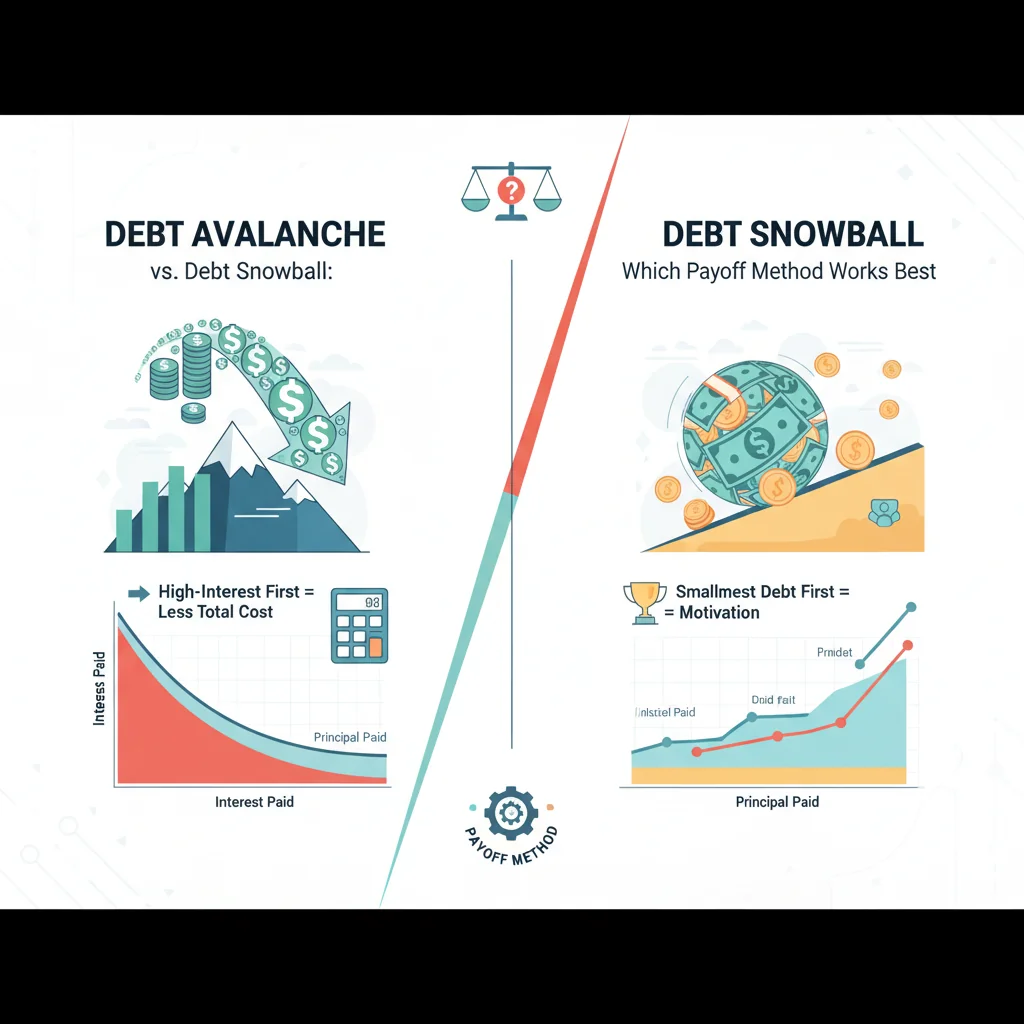
Debt Payoff Methods Definition: The debt avalanche and debt snowball are two popular strategies for paying off multiple debts. The debt avalanche prioritizes debts by interest rate, saving the most money over time, while the debt snowball prioritizes debts by smallest balance, providing psychological wins to maintain motivation.
Understanding the Debt Payoff Landscape
Debt can feel like a heavy burden, impacting everything from your daily stress levels to your long-term financial goals. For many Americans, it's a pervasive issue. According to the Federal Reserve's 2023 Survey of Consumer Finances, approximately 45.4% of U.S. families carry some form of credit card debt, with the average household credit card debt reaching over $7,000. This doesn't even account for personal loans, medical bills, or other forms of consumer debt. While some debt, like a mortgage or student loans, can be considered "good debt" if managed properly, high-interest consumer debt can quickly derail financial progress. Without a clear strategy, it's easy to get caught in a cycle of minimum payments, leading to prolonged debt and significant interest accumulation. This section will explore why a structured approach is crucial and introduce the two primary contenders in the debt payoff arena.
Why a Debt Payoff Strategy is Essential
Simply making minimum payments on multiple debts is often a recipe for financial stagnation. Minimum payments are designed to keep you in debt longer, maximizing the interest collected by lenders. For example, paying only the minimum on a $5,000 credit card balance with an 18% APR could take over 15 years to pay off and cost thousands in interest. A structured debt payoff strategy provides a clear roadmap, transforming an overwhelming collection of bills into a manageable process. It helps you allocate your extra funds strategically, either to save the most money or to build momentum, ultimately leading to faster debt freedom. Without a plan, the temptation to spend any extra income rather than apply it to debt can be strong. A defined strategy creates accountability and focuses your efforts.
An Overview of Debt Avalanche and Debt Snowball
The two most widely discussed and implemented debt payoff strategies are the debt avalanche and the debt snowball. Both methods involve making minimum payments on all debts except for one, to which you apply all available extra funds. The difference lies in how that "target" debt is chosen. The debt avalanche method prioritizes debts based on their interest rates, tackling the highest-interest debt first. This approach is mathematically superior, as it minimizes the total interest paid. In contrast, the debt snowball method prioritizes debts based on their balance, starting with the smallest debt first. This strategy is designed to provide psychological wins as you quickly pay off smaller debts, building momentum and motivation to continue. Understanding these fundamental differences is key to determining which method aligns best with your financial personality and goals.
The Debt Avalanche Method: Maximizing Savings
The debt avalanche method is often lauded by financial experts for its mathematical efficiency. It’s a straightforward strategy that targets your debts in a specific order: from the highest interest rate to the lowest. The core principle is to minimize the total amount of interest you pay over the life of your debts, thereby saving you the most money in the long run. This method requires a disciplined approach and a clear understanding of your debt's interest rates. For someone like Michael, who is looking to optimize his finances and save as much as possible, the debt avalanche presents a compelling option, especially given his existing credit card debt which likely carries high-interest rates.
How the Debt Avalanche Works
To implement the debt avalanche method, you first need to list all your debts, along with their current balances and, crucially, their annual percentage rates (APRs). Once you have this list, you'll arrange them in descending order of APR, from highest to lowest. Your strategy then involves making the minimum required payment on all debts except for the one at the very top of your list—the debt with the highest interest rate. All additional funds you can spare each month are then directed towards this highest-interest debt. Once that debt is completely paid off, you take the money you were paying on it (both the minimum payment and the extra funds) and roll it into the next debt on your list, which now has the highest remaining interest rate. You continue this process, "avalanching" your payments from one debt to the next until all debts are clear. This systematic approach ensures that you are always attacking the most expensive debt first.
Advantages of the Debt Avalanche
The primary advantage of the debt avalanche method is its cost-effectiveness. By focusing on debts with the highest interest rates, you reduce the total amount of interest paid over time. This means you reach debt freedom faster and with less money spent overall compared to other methods. For example, if Michael has a credit card with a 24% APR and another with a 15% APR, paying off the 24% card first will save him significantly more interest than paying off the 15% card first, even if the 15% card has a smaller balance. This method is particularly beneficial for individuals with substantial high-interest debt, such as credit card balances or personal loans. The financial savings can be substantial, providing a tangible reward for your discipline.
Disadvantages of the Debt Avalanche
While mathematically superior, the debt avalanche method can sometimes be challenging from a psychological perspective. If your highest-interest debt also happens to be a large balance, it might take a considerable amount of time before you see that debt fully paid off. This lack of immediate "wins" can be demotivating for some individuals, making it harder to stick to the plan, especially if they are new to debt management. For those who need frequent reinforcement to stay on track, the slow progress on a large debt might lead to frustration or even abandonment of the strategy. It requires a high degree of financial discipline and patience to see it through to the end.
The Debt Snowball Method: Building Momentum
The debt snowball method is a popular debt reduction strategy that focuses on psychological motivation rather than mathematical optimization. Developed by financial personality Dave Ramsey, this method prioritizes paying off debts with the smallest balances first, regardless of their interest rates. The idea is that by quickly eliminating smaller debts, you gain momentum and confidence, which fuels your motivation to tackle larger debts. This approach can be particularly effective for individuals who feel overwhelmed by their debt and need tangible victories to stay committed to their payoff journey.
How the Debt Snowball Works
To execute the debt snowball method, you begin by listing all your debts from the smallest balance to the largest balance. Similar to the avalanche method, you make minimum payments on all your debts except for the one at the top of your list—the debt with the smallest outstanding balance. All extra money you can allocate to debt repayment is then directed towards this smallest debt. Once that smallest debt is completely paid off, you take the money you were paying on it (both the minimum payment and the extra funds) and "snowball" it into the next smallest debt on your list. This process continues, with each paid-off debt freeing up more money to throw at the next smallest debt, creating a growing "snowball" of payments. The psychological boost from seeing debts disappear quickly is the driving force behind this method.
Advantages of the Debt Snowball
The primary advantage of the debt snowball method is its psychological impact. By paying off smaller debts quickly, you experience immediate wins and a sense of accomplishment. These frequent successes can be incredibly motivating, helping you stay committed to your debt payoff plan even when facing larger, more daunting balances. For someone like Michael, who might be feeling overwhelmed by his $8,200 in credit card debt spread across multiple cards, quickly eliminating a $500 balance could provide the necessary boost to continue. This method is ideal for individuals who tend to lose motivation easily or who need tangible progress to maintain their focus. It transforms the often-arduous process of debt repayment into a series of achievable milestones.
Disadvantages of the Debt Snowball
While excellent for motivation, the main drawback of the debt snowball method is that it is mathematically less efficient than the debt avalanche. By not prioritizing debts by interest rate, you will likely pay more in total interest over the life of your debts and take longer to become debt-free. For instance, if your smallest debt has a 10% APR but you also have a larger debt with a 25% APR, paying off the 10% debt first means you're allowing the 25% debt to accrue more interest for a longer period. Over time, these additional interest payments can add up to hundreds or even thousands of dollars. This trade-off between psychological benefit and financial cost is the central consideration when choosing between the two methods.
Comparing Debt Avalanche and Debt Snowball
When deciding between the debt avalanche and debt snowball methods, it's crucial to understand their core differences and how they impact your financial outcome and personal motivation. Both are effective strategies for debt repayment, but they cater to different priorities and psychological needs. A direct comparison can help illustrate which method might be a better fit for your specific situation, taking into account factors like your current debt profile, financial discipline, and need for quick wins.
Key Differences and Similarities
The fundamental difference between the debt avalanche and debt snowball lies in the order debts are tackled. The debt avalanche prioritizes debts by highest interest rate first, aiming to minimize the total cost of debt. The debt snowball prioritizes debts by smallest balance first, aiming to maximize psychological momentum. Both methods share a common core: you make minimum payments on all debts except for one, to which you apply all available extra funds. Once that target debt is paid off, the freed-up payment amount is rolled into the next debt on the list. This "snowballing" or "avalanching" of payments is what accelerates the payoff process beyond simply making minimum payments.
Here's a table summarizing their key characteristics:
| Feature | Debt Avalanche | Debt Snowball |
|---|---|---|
| Prioritization | Highest interest rate first | Smallest balance first |
| Primary Benefit | Saves the most money (least interest paid) | Builds psychological momentum (quick wins) |
| Ideal For | Disciplined individuals, high-interest debt | Those needing motivation, easily overwhelmed |
| Time to Payoff | Potentially shorter (due to interest savings) | Potentially longer (due to higher interest paid) |
| Total Cost | Lower | Higher |
| Motivation | Relies on long-term financial gain | Relies on short-term victories |
Real-World Example: Michael's Debt Scenario
Let's apply both methods to Michael's situation. He has $8,200 in credit card debt spread across three cards. For simplicity, let's assume his debts are:
- Credit Card A: Balance $1,200, APR 22%, Minimum Payment $40
- Credit Card B: Balance $3,000, APR 18%, Minimum Payment $75
- Credit Card C: Balance $4,000, APR 25%, Minimum Payment $100
Michael has an extra $200 per month he can dedicate to debt repayment.
Debt Avalanche for Michael:
- Order by APR (highest to lowest):
- Credit Card C: $4,000, APR 25%
- Credit Card A: $1,200, APR 22%
- Credit Card B: $3,000, APR 18%
Strategy: Michael makes minimum payments on Card A ($40) and Card B ($75). He directs his entire extra $200, plus Card C's minimum payment of $100, towards Credit Card C. So, $300/month goes to Card C.
Outcome: Card C will be paid off first. Once Card C is gone, Michael takes the $300 he was paying on it and adds it to Card A's minimum payment ($40), sending $340/month to Card A. After Card A is paid, he rolls that $340 + Card B's minimum ($75) into Card B, paying $415/month until it's clear. This method will save Michael the most money in interest.
Debt Snowball for Michael:
- Order by Balance (smallest to largest):
- Credit Card A: $1,200, APR 22%
- Credit Card B: $3,000, APR 18%
- Credit Card C: $4,000, APR 25%
Strategy: Michael makes minimum payments on Card B ($75) and Card C ($100). He directs his entire extra $200, plus Card A's minimum payment of $40, towards Credit Card A. So, $240/month goes to Card A.
Outcome: Card A will be paid off quickly. Once Card A is gone, Michael takes the $240 he was paying on it and adds it to Card B's minimum payment ($75), sending $315/month to Card B. After Card B is paid, he rolls that $315 + Card C's minimum ($100) into Card C, paying $415/month until it's clear. Michael will experience quicker wins, but he will pay more interest overall because Card C (25% APR) is paid off last.
This example clearly illustrates the different paths and outcomes. While the snowball offers a quicker psychological boost by eliminating Card A first, the avalanche tackles the most expensive debt (Card C) first, leading to greater financial savings.
Which Method is Right for You?
The choice between the debt avalanche and debt snowball ultimately depends on your personal financial psychology and priorities.
- Choose the Debt Avalanche if:
- You are highly disciplined and motivated by financial efficiency.
- You have a good understanding of your debt's interest rates.
- You want to save the maximum amount of money on interest.
- You can stay motivated even if it takes longer to pay off the first large, high-interest debt.
- Financial advisors often recommend this method for its mathematical superiority.
- Choose the Debt Snowball if:
- You need frequent wins and psychological boosts to stay motivated.
- You feel overwhelmed by the sheer number of debts you have.
- You've tried other methods and struggled to stick with them.
- You prioritize momentum and confidence over minimizing total interest paid.
- The difference in total interest paid between the methods is not a significant concern for you.
Ultimately, the "best" method is the one you will stick with. A strategy that saves you more money but you abandon halfway through is less effective than a strategy that costs slightly more but you see through to completion. Consider your personality and past financial behaviors carefully before making your decision.
Practical Steps to Implement Your Chosen Strategy
Once you've decided whether the debt avalanche or debt snowball method aligns better with your financial personality and goals, the next crucial step is to put that plan into action. Implementation involves more than just picking a strategy; it requires organization, commitment, and often, finding ways to free up additional funds. This section will guide you through the practical steps needed to successfully apply your chosen debt payoff method and accelerate your journey to financial freedom.
Step 1: Gather All Debt Information
Before you can apply either the avalanche or snowball method, you need a complete and accurate picture of your current debt situation. This means listing every single debt you have, no matter how small. For each debt, gather the following critical information:
- Creditor Name: (e.g., Visa, Discover, Personal Loan Company)
- Current Balance: The exact amount you still owe.
- Interest Rate (APR): This is crucial, especially for the avalanche method.
- Minimum Monthly Payment: The lowest amount you are required to pay each month.
- Due Date: To ensure you don't miss payments.
You can typically find this information on your monthly statements, online banking portals, or by contacting your creditors directly. Organize this data in a spreadsheet or a simple list. For Michael, this would mean listing his three credit cards with their respective balances, APRs, and minimum payments. This comprehensive overview is the foundation of your debt payoff plan.
Step 2: Choose Your Method and Order Your Debts
With all your debt information in hand, it's time to formally choose your strategy and order your debts accordingly.
- For Debt Avalanche: Arrange your debts from the highest interest rate to the lowest interest rate. The debt with the highest APR goes at the top of your list.
- For Debt Snowball: Arrange your debts from the smallest balance to the largest balance. The debt with the lowest outstanding balance goes at the top of your list.
This ordered list will be your roadmap. It clearly shows which debt you will attack first and the sequence for all subsequent debts.
Step 3: Create a Budget and Find Extra Funds
To accelerate your debt payoff, you need to find extra money beyond your minimum payments to apply to your target debt. This is where a detailed budget becomes indispensable.
- Track Your Spending: For at least a month, meticulously track every dollar you spend. This will reveal where your money is actually going.
- Identify Areas for Cuts: Look for non-essential expenses you can reduce or eliminate. This might include dining out less, canceling unused subscriptions, reducing entertainment costs, or finding cheaper alternatives for daily necessities. Even small cuts can add up.
- Increase Your Income: Consider side hustles, selling unused items, or asking for a raise. Every extra dollar you can dedicate to debt will shorten your payoff time and reduce interest.
According to a 2023 survey by the National Endowment for Financial Education (NEFE), nearly two-thirds of Americans (65%) admit that their spending habits are a barrier to saving money. By actively budgeting and finding additional funds, Michael can turn his $200 extra per month into a powerful debt-fighting tool. Remember, the more you can consistently apply to your target debt, the faster you'll achieve debt freedom.
Step 4: Automate Payments and Stay Consistent
Consistency is key to the success of either the debt avalanche or debt snowball.
- Automate Minimum Payments: Set up automatic minimum payments for all your debts. This ensures you never miss a payment, avoiding late fees and negative impacts on your credit score.
- Manually Apply Extra Funds: For your target debt, you will need to manually make an additional payment each month, combining its minimum payment with all your extra funds. Make sure to specify that this extra payment should go towards the principal balance, if possible, to maximize its impact.
- Monitor Progress: Regularly review your debt balances and celebrate each debt you pay off. Seeing your progress will help maintain motivation. For Michael, watching his first credit card balance drop rapidly using the snowball method, or seeing the overall interest savings accumulate with the avalanche, would be crucial for long-term adherence.
Sticking to your plan, even when unexpected expenses arise, is vital. If you face a setback, don't give up. Adjust your budget, reassess your extra funds, and get back on track as quickly as possible. The journey to debt freedom is often a marathon, not a sprint.
Beyond Avalanche and Snowball: Other Considerations
While the debt avalanche and debt snowball are powerful strategies, they aren't the only tools in your debt management arsenal. Depending on your financial situation and the types of debt you carry, exploring other options or incorporating additional tactics can further accelerate your progress. Understanding these complementary approaches can provide a more holistic strategy for achieving financial freedom.
Debt Consolidation and Refinancing
For individuals with multiple high-interest debts, debt consolidation or refinancing can be a viable option. This involves taking out a new loan—often a personal loan or a balance transfer credit card—to pay off several existing debts. The goal is to simplify your payments into one monthly bill, ideally at a lower interest rate.
- Balance Transfer Credit Cards: These cards offer a promotional 0% APR for an introductory period (typically 12-21 months) on transferred balances. This can be a powerful way to pay down high-interest credit card debt without accruing additional interest, provided you can pay off the balance before the promotional period ends. Be aware of balance transfer fees, which are usually 3-5% of the transferred amount.
- Personal Loans: A personal loan can consolidate various debts into a single, fixed-rate loan with a predictable monthly payment. If you qualify for a lower interest rate than your current average, this can save you money and simplify your finances. However, approval depends on your credit score and debt-to-income ratio.
For Michael, with $8,200 in credit card debt, a balance transfer card could be a strong consideration if he believes he can pay off a significant portion within the introductory period. Alternatively, a personal loan might offer a lower, fixed interest rate compared to his credit cards, providing more stability. However, it's crucial to avoid accumulating new debt on the old credit cards once they are paid off.
Negotiating with Creditors
Don't underestimate the power of direct communication with your creditors. If you're struggling to make payments, reaching out to them can sometimes lead to favorable outcomes.
- Lower Interest Rates: Many credit card companies are willing to lower your interest rate if you have a good payment history and simply ask. A lower APR directly translates to less interest paid and faster debt repayment.
- Payment Plans or Hardship Programs: If you're facing financial hardship, creditors may offer temporary payment plans, deferred payments, or even a reduced settlement amount. While a settlement can negatively impact your credit score, it might be a necessary step to avoid bankruptcy in extreme cases.
A quick phone call to your credit card companies could potentially reduce Michael's 22% or 25% APRs, making his debt more manageable and accelerating his payoff, regardless of whether he chooses the avalanche or snowball method.
Building an Emergency Fund
While aggressively paying down debt is important, it's equally critical to build or maintain an emergency fund. An emergency fund acts as a financial safety net, preventing you from falling back into debt when unexpected expenses arise. The Federal Reserve's 2023 Report on the Economic Well-Being of U.S. Households indicated that 37% of adults would not be able to cover an unexpected $400 expense using cash or its equivalent.
Financial advisors often recommend having 3-6 months' worth of essential living expenses saved in an easily accessible, separate savings account. For someone like Michael, who currently has no emergency fund coverage, prioritizing a small starter emergency fund (e.g., $1,000) before going all-in on debt repayment can be a wise move. This "mini-fund" can prevent new debt from accumulating if his car breaks down or he faces an unexpected medical bill. Once the starter fund is in place, he can then aggressively tackle his debt, knowing he has a buffer.
Frequently Asked Questions
What is the main difference between debt avalanche and debt snowball?
The main difference lies in their prioritization strategy: the debt avalanche targets debts with the highest interest rates first to save the most money on interest, while the debt snowball targets debts with the smallest balances first to build psychological momentum through quick wins.
Which debt payoff method saves the most money?
The debt avalanche method consistently saves the most money because it focuses on eliminating the debts that cost you the most in interest first. By paying off high-interest debts sooner, you reduce the total amount of interest accrued over time.
Is the debt snowball method ever better than the debt avalanche?
The debt snowball method can be better for individuals who struggle with motivation and need frequent psychological wins to stay committed to their debt payoff plan. While it may cost more in interest, the increased likelihood of sticking to the plan and becoming debt-free makes it a superior choice for certain personality types.
How do I start the debt avalanche method?
To start the debt avalanche method, list all your debts with their balances and interest rates. Order them from the highest interest rate to the lowest. Make minimum payments on all debts except the one with the highest interest rate, to which you direct all available extra funds.
How do I start the debt snowball method?
To start the debt snowball method, list all your debts with their balances. Order them from the smallest balance to the largest. Make minimum payments on all debts except the one with the smallest balance, to which you direct all available extra funds.
Should I build an emergency fund before paying off debt?
It's generally recommended to build a small "starter" emergency fund (e.g., $1,000) before aggressively paying off debt. This provides a buffer against unexpected expenses, preventing you from incurring new debt. Once this initial fund is established, you can then focus more intensely on debt repayment.
Can I combine aspects of both debt avalanche and debt snowball?
Yes, you can create a hybrid approach. For example, you might tackle one or two very small debts using the snowball method for quick wins, then switch to the avalanche method for your remaining higher-interest debts. The most effective strategy is one you can consistently follow.
Key Takeaways
- Debt Avalanche vs. Debt Snowball: These are two distinct debt payoff strategies, one focused on mathematical efficiency and the other on psychological motivation.
- Debt Avalanche Benefits: This method saves the most money by prioritizing debts with the highest interest rates, reducing the total interest paid over time.
- Debt Snowball Benefits: This method builds momentum and motivation by tackling the smallest debts first, providing quick wins to keep you engaged.
- Personalized Choice: The "best" method depends on your individual financial discipline and psychological needs; the one you stick with is the most effective.
- Practical Implementation: Regardless of the chosen method, gather all debt information, create a budget to find extra funds, and automate payments for consistency.
- Holistic Approach: Consider debt consolidation, negotiating with creditors, and building an emergency fund as complementary strategies to accelerate your debt freedom journey.
Conclusion
Navigating the path to financial freedom can feel daunting, especially when faced with multiple debts. For someone like Michael, with $8,200 in credit card debt and a wedding on the horizon, choosing the right debt payoff strategy is a critical step towards securing his financial future. Whether he opts for the mathematically superior debt avalanche to save the most money or the psychologically empowering debt snowball to maintain motivation, the most important decision is to choose a method and stick with it. By understanding the mechanics, advantages, and disadvantages of each, you can make an informed choice that aligns with your personal financial style.
Remember, the goal isn't just to pay off debt, but to build sustainable financial habits. By diligently applying your chosen strategy, finding extra funds through budgeting, and staying consistent, you can transform your financial outlook. Michael, after carefully weighing his options, decided to start with the debt snowball to quickly eliminate his smallest credit card balance, giving him the confidence boost he needed. Once that was gone, he plans to switch to an avalanche approach for his remaining, higher-interest debts, blending both strategies for optimal results. With a clear plan, commitment, and perhaps a few strategic phone calls to his creditors, Michael will be well on his way to debt-free living before his wedding, securing a stronger financial foundation for his future.
Disclaimer: This article is for informational and educational purposes only and does not constitute financial, investment, or tax advice. Always consult a qualified financial advisor before making investment decisions.
The information provided in this article is for educational purposes only and does not constitute financial, investment, or legal advice. Always consult with a qualified financial advisor, tax professional, or legal counsel for personalized guidance tailored to your specific situation before making any financial decisions.
Comments
No comments yet. Be the first to comment!
More from Personal Finance


Explore Related Guides
Expert reviews of Gold IRA companies, rollover guides, fees, and IRS rules.
Comprehensive investment strategies covering stocks, bonds, ETFs, crypto, and real estate.
Compare banking products, interest rates, and strategies to maximize your savings.