
Corporate Bonds vs Treasury Bonds: Risk and Return Compared
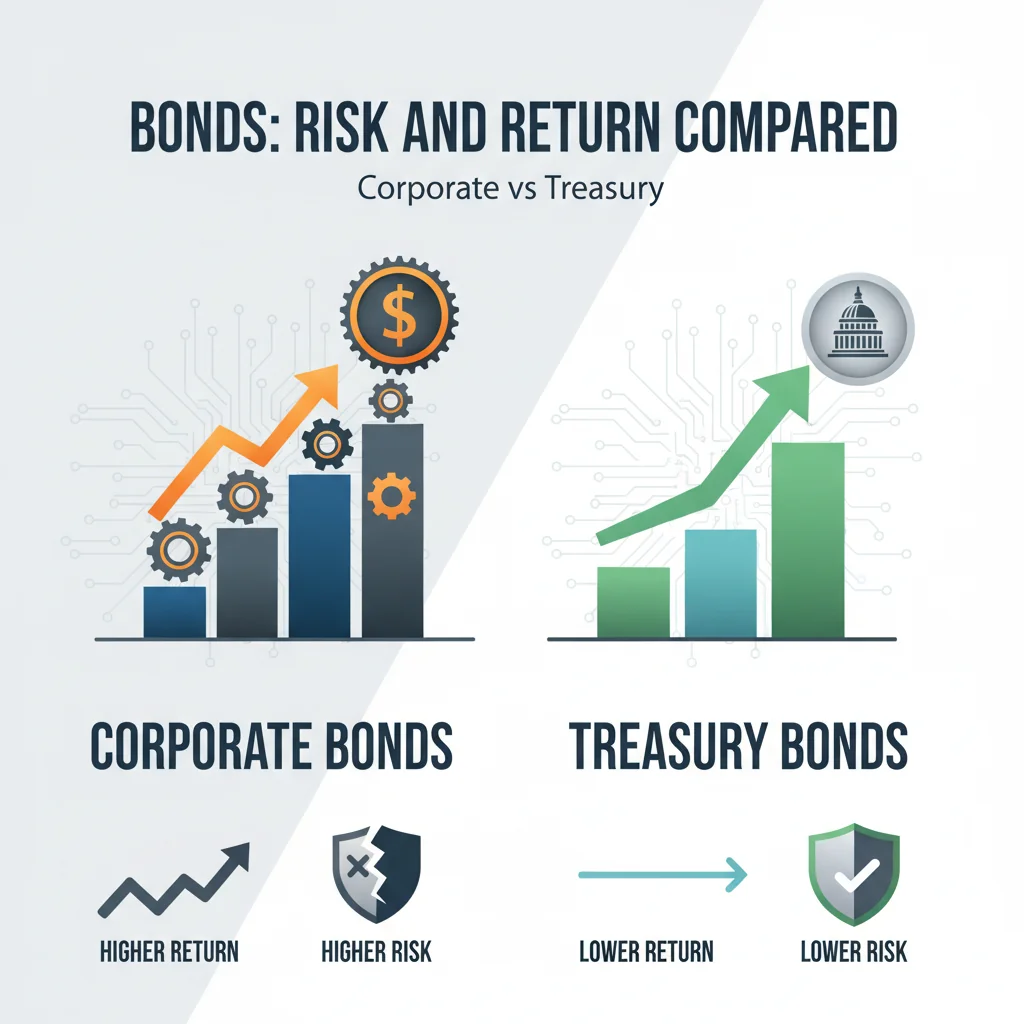
Investing in bonds can be a cornerstone of a diversified financial portfolio, offering stability and income potential that often contrasts with the volatility of stocks. However, not all bonds are created equal, and understanding the fundamental differences between types is crucial for making informed investment decisions. Many investors, seeking to balance growth with capital preservation, find themselves weighing the merits of corporate bonds against Treasury bonds. While both represent a loan made by an investor to an issuer in exchange for interest payments, their underlying characteristics, particularly concerning risk and potential return, vary significantly. Navigating these differences is essential for aligning bond investments with individual financial goals and risk tolerance.
Corporate Bonds vs Treasury Bonds Definition: Corporate bonds are debt securities issued by companies to raise capital, while Treasury bonds are debt securities issued by the U.S. government to finance its operations. The primary distinctions lie in their issuer, credit risk, and corresponding yield.
Understanding the Fundamentals: What Are Bonds?
Bonds are essentially IOUs. When you buy a bond, you are lending money to an entity – a government, a municipality, or a corporation – for a defined period. In return for this loan, the issuer promises to pay you, the bondholder, a fixed or variable interest rate over the bond's life, and to repay the principal amount (face value) when the bond matures. This makes bonds a critical component of the fixed-income market, appealing to investors seeking predictable income streams and capital preservation.
The allure of bonds stems from their role in portfolio diversification. They often exhibit a lower correlation with stocks, meaning they may perform well when stocks are declining, providing a buffer against market volatility. However, the bond market is not monolithic. The specific characteristics of a bond, including its issuer, maturity date, coupon rate, and embedded options, all contribute to its risk profile and potential return. Understanding these foundational elements is the first step in differentiating between various bond types, such as corporate bonds and Treasury bonds.
Key Bond Terminology
To effectively compare corporate and Treasury bonds, it's important to be familiar with the common language of the bond market. These terms dictate how a bond functions and how its value is assessed.
- Face Value (Par Value): This is the principal amount of the bond that the issuer promises to repay at maturity. Most bonds have a face value of $1,000.
- Coupon Rate: The annual interest rate paid by the bond issuer on the bond's face value. This rate determines the periodic interest payments (coupon payments) received by the bondholder. For example, a $1,000 bond with a 5% coupon rate pays $50 per year.
- Maturity Date: The date on which the issuer repays the bond's face value to the bondholder. Bonds can have maturities ranging from a few months (short-term) to 30 years or more (long-term).
- Yield to Maturity (YTM): The total return an investor can expect to receive if they hold the bond until it matures, taking into account the bond's current market price, par value, coupon interest rate, and time to maturity. YTM is a more comprehensive measure of return than the coupon rate, especially if a bond is bought at a discount or premium.
- Credit Rating: An assessment of the issuer's ability to meet its financial obligations. Agencies like Standard & Poor's (S&P), Moody's, and Fitch assign ratings (e.g., AAA, AA, BBB) that indicate the likelihood of default. Higher ratings signify lower risk.
- Interest Rate Risk: The risk that changes in prevailing interest rates will affect the value of a bond. When interest rates rise, the value of existing bonds with lower coupon rates typically falls, and vice versa.
- Inflation Risk: The risk that the purchasing power of a bond's future interest payments and principal repayment will be eroded by inflation.
How Bonds Fit into a Portfolio
Bonds serve multiple strategic purposes within an investment portfolio. They are often seen as a counterbalance to the higher volatility of equities, providing a degree of stability and capital preservation. For instance, during periods of economic uncertainty or market downturns, bonds, particularly high-quality government bonds, tend to hold their value better than stocks, acting as a "safe haven."
Furthermore, bonds provide a reliable income stream, which can be particularly attractive for retirees or those seeking consistent cash flow. The fixed coupon payments offer predictability, making financial planning easier. According to the Federal Reserve's 2022 Survey of Consumer Finances, fixed-income assets, including bonds, constitute a significant portion of older households' portfolios, reflecting their preference for income and capital preservation as they approach and enter retirement. Beyond income and stability, bonds can also be used for diversification, reducing overall portfolio risk by combining assets that don't move in perfect lockstep.
Corporate Bonds: Financing Business Growth
Corporate bonds are debt instruments issued by corporations to raise capital for various business purposes, such as expanding operations, funding research and development, acquiring other companies, or refinancing existing debt. When you purchase a corporate bond, you are essentially lending money to a company, and in return, the company promises to pay you interest over a specified period and repay your principal at maturity.
These bonds come in a wide array of structures and risk profiles, reflecting the diverse financial health and business models of the issuing companies. From blue-chip giants to emerging startups, any publicly traded or even private company can issue corporate bonds. The terms of these bonds—coupon rate, maturity, and embedded features—are heavily influenced by the issuer's creditworthiness and the prevailing market interest rates.
Types of Corporate Bonds
The corporate bond market is highly segmented, offering various types of bonds tailored to different investor needs and corporate financing strategies. Understanding these variations is key to assessing their risk and return potential.
- Investment-Grade Bonds: These are issued by companies with strong financial health and a low probability of default, as rated by credit agencies (e.g., BBB- or higher by S&P, Baa3 or higher by Moody's). They offer lower yields compared to speculative-grade bonds but are considered safer. Many institutional investors, like pension funds and insurance companies, are often restricted to investing primarily in investment-grade bonds due to regulatory requirements.
- High-Yield Bonds (Junk Bonds): Issued by companies with lower credit ratings (BB+ or lower by S&P, Ba1 or lower by Moody's), these bonds carry a higher risk of default. To compensate investors for this increased risk, they offer significantly higher coupon rates and yields. While they present greater risk, they can also provide substantial returns for investors willing to take on that risk.
- Convertible Bonds: These bonds give the holder the option to convert them into a specified number of shares of the issuing company's common stock. This feature allows investors to participate in the potential upside of the company's stock while still receiving fixed-income payments. Convertible bonds typically offer lower coupon rates than non-convertible bonds from the same issuer because of the added equity potential.
- Callable Bonds: These bonds give the issuer the right to redeem the bond before its maturity date, often at a specified price. Companies typically call bonds when interest rates have fallen, allowing them to refinance their debt at a lower cost. This feature introduces reinvestment risk for the bondholder, as they may have to reinvest their principal at a lower prevailing interest rate.
- Puttable Bonds: Conversely, puttable bonds give the bondholder the right to sell the bond back to the issuer at a specified price on certain dates before maturity. This feature is beneficial to investors if interest rates rise, allowing them to exit the bond and reinvest at higher rates.
Risks Associated with Corporate Bonds
While corporate bonds offer attractive yields, they come with inherent risks that investors must carefully consider. These risks are generally higher than those associated with government bonds.
- Credit Risk (Default Risk): This is the most significant risk for corporate bonds. It's the risk that the issuing company will be unable to make its promised interest payments or repay the principal at maturity. Credit ratings from agencies like Moody's and S&P are designed to assess this risk. A company's financial health, industry outlook, and overall economic conditions can all impact its ability to meet its debt obligations. For example, during economic downturns, corporate defaults tend to rise, as seen during the 2008 financial crisis.
- Interest Rate Risk: Like all fixed-income securities, corporate bonds are sensitive to changes in interest rates. When market interest rates rise, the value of existing bonds with lower fixed coupon rates typically falls, as new bonds are issued with higher rates, making older bonds less attractive. Conversely, when rates fall, bond prices tend to rise. The longer a bond's maturity, the more sensitive its price is to interest rate changes.
- Liquidity Risk: This is the risk that an investor may not be able to sell a bond quickly at a fair market price. Some corporate bonds, particularly those issued by smaller companies or with unusual features, may have a thin trading market, making it difficult to find a buyer without significantly discounting the price. Highly liquid bonds, on the other hand, can be bought or sold easily.
- Call Risk: For callable bonds, this is the risk that the issuer will redeem the bond before its maturity date. This typically happens when interest rates have fallen, forcing the investor to reinvest their principal at a lower yield. This can disrupt an investor's income stream and reduce their overall return.
Treasury Bonds: The Benchmark of Safety
Treasury bonds, often referred to as "Treasuries," are debt securities issued by the U.S. Department of the Treasury to finance the federal government's spending. They are considered among the safest investments in the world because they are backed by the "full faith and credit" of the U.S. government, implying an extremely low risk of default. This makes them a benchmark for other fixed-income investments and a cornerstone of many conservative investment portfolios.
The U.S. government issues various types of Treasury securities with different maturities, each serving slightly different purposes and appealing to different investor needs. These include Treasury Bills (T-Bills), Treasury Notes (T-Notes), and Treasury Bonds (T-Bonds), differentiated primarily by their maturity periods.
Types of Treasury Securities
The U.S. Treasury offers a range of securities to meet diverse financing needs and investor preferences.
- Treasury Bills (T-Bills): These are short-term debt instruments with maturities of 4, 8, 13, 17, 26, or 52 weeks. T-Bills are sold at a discount to their face value and do not pay periodic interest. The return comes from the difference between the purchase price and the face value received at maturity. They are considered very liquid and have minimal interest rate risk due to their short duration.
- Treasury Notes (T-Notes): T-Notes have intermediate maturities, typically 2, 3, 5, 7, and 10 years. They pay fixed interest payments every six months until maturity, at which point the principal is repaid. The 10-year Treasury Note is often cited as a benchmark for long-term interest rates in the U.S. economy.
- Treasury Bonds (T-Bonds): These are long-term debt instruments with maturities of 20 or 30 years. Like T-Notes, they pay fixed interest every six months until maturity. Due to their long maturities, T-Bonds are more sensitive to interest rate fluctuations than T-Bills or T-Notes.
- Treasury Inflation-Protected Securities (TIPS): TIPS are a unique type of Treasury security designed to protect investors from inflation. Their principal value adjusts with the Consumer Price Index (CPI), increasing with inflation and decreasing with deflation. While the coupon rate is fixed, the actual interest payment varies because it's applied to the inflation-adjusted principal. This makes TIPS particularly attractive to investors concerned about the erosion of purchasing power.
Risks Associated with Treasury Bonds
While Treasury bonds are lauded for their safety, they are not entirely risk-free. Investors should be aware of the specific risks, albeit generally lower than other bond types, that can still impact their returns.
- Interest Rate Risk: This is the primary risk for Treasury bonds, particularly those with longer maturities. If market interest rates rise after you purchase a Treasury bond, the market value of your existing bond will fall. This means if you need to sell the bond before maturity, you might receive less than you paid for it. Conversely, if rates fall, your bond's value will increase. For example, a 30-year T-Bond will experience much larger price swings than a 2-year T-Note for the same change in interest rates.
- Inflation Risk: Although TIPS specifically address this, conventional Treasury bonds are still susceptible to inflation risk. If inflation rises unexpectedly, the fixed interest payments and the principal repayment at maturity will have less purchasing power. This can lead to a negative real return, even if the nominal return is positive. This risk is particularly relevant for long-term bonds, as inflation can have a greater cumulative effect over extended periods.
- Reinvestment Risk: This risk arises when interest rates decline. If you own a bond that matures or is called, and prevailing interest rates are lower, you will have to reinvest your principal at a lower yield. This can reduce your overall income stream, especially for those relying on bond income. While the U.S. government does not call its conventional bonds, this risk is still present when bonds mature and the proceeds need to be reinvested.
- Liquidity Risk (Minimal): While the U.S. Treasury market is one of the most liquid markets globally, certain off-the-run (older, less actively traded) Treasury issues might have slightly less liquidity than the most recently issued benchmark Treasuries. However, for most investors, liquidity is rarely a significant concern with U.S. Treasuries.
Corporate Bonds vs Treasury Bonds: A Direct Comparison
When evaluating investment options, a direct comparison of corporate bonds and Treasury bonds highlights their distinct characteristics and helps investors determine which best suits their financial objectives and risk tolerance. The core differences revolve around the issuer's creditworthiness, the associated risk of default, and the compensation investors receive for taking on that risk.
Issuer and Creditworthiness
The fundamental distinction between corporate and Treasury bonds lies in their issuer. Treasury bonds are issued by the U.S. government, which has the power to tax and print money, making it an extremely reliable borrower. This backing by the "full faith and credit" of the U.S. government means that the risk of default on Treasury securities is considered negligible, often referred to as risk-free in financial theory.
Corporate bonds, on the other hand, are issued by private companies. The creditworthiness of these issuers varies widely, from highly stable, financially robust corporations with excellent credit ratings (investment-grade) to companies with weaker financial positions and higher default risk (high-yield or junk bonds). The ability of a corporation to repay its debt depends on its business performance, market conditions, and overall economic health. This introduces a significant layer of credit risk that is absent in Treasury bonds.
Risk and Return Profile
The difference in creditworthiness directly translates into varying risk and return profiles.
- Treasury Bonds: Due to their virtually default-free nature, Treasury bonds offer lower yields compared to corporate bonds of similar maturity. Investors are willing to accept a lower return in exchange for the highest level of safety. Their primary risks are interest rate risk and inflation risk, not default risk. For example, in early 2024, the yield on a 10-year U.S. Treasury Note hovered around 4.0-4.5%, reflecting its low-risk status.
- Corporate Bonds: To compensate investors for taking on credit risk, corporate bonds generally offer higher yields than Treasury bonds. This difference in yield is known as the credit spread. The higher the perceived credit risk of a corporation, the larger the credit spread (and thus the higher the yield) it must offer to attract investors. For instance, an investment-grade corporate bond might yield 1-2 percentage points more than a comparable Treasury, while a high-yield bond could offer 5-10 percentage points more, depending on market conditions and the issuer's specific risk.
Liquidity and Market Depth
The liquidity of a bond refers to how easily it can be bought or sold in the market without significantly affecting its price.
- Treasury Bonds: The U.S. Treasury market is one of the largest and most liquid financial markets in the world. Billions of dollars in Treasuries are traded daily, making it easy for investors to buy or sell these securities quickly and efficiently. This high liquidity is another factor contributing to their lower yields.
- Corporate Bonds: The liquidity of corporate bonds can vary significantly. While bonds issued by large, well-known corporations with high credit ratings tend to be relatively liquid, especially in the primary market, bonds from smaller issuers or those with less common features may have thinner trading volumes. This means an investor might have to accept a lower price to sell quickly or wait longer to find a buyer at a desired price, posing a liquidity risk.
Tax Implications
The tax treatment of interest income from bonds can also be a differentiating factor for investors.
- Treasury Bonds: Interest income from U.S. Treasury securities is exempt from state and local income taxes but is subject to federal income tax. This can be an advantage for residents of states with high income taxes.
- Corporate Bonds: Interest income from corporate bonds is generally subject to federal, state, and local income taxes. This means that for investors in higher tax brackets, the after-tax yield of a corporate bond might be less attractive than its pre-tax yield suggests, especially when compared to tax-advantaged alternatives.
Here's a summary table comparing the key attributes:
| Feature | Corporate Bonds | Treasury Bonds |
|---|---|---|
| Issuer | Private corporations | U.S. Federal Government |
| Credit Risk | Varies (low for investment-grade, high for junk) | Virtually zero (backed by U.S. government) |
| Default Risk | Present, depends on issuer's financial health | Extremely low, considered negligible |
| Yield | Generally higher (to compensate for risk) | Generally lower (due to high safety) |
| Liquidity | Varies (high for large issues, low for small) | Very high (one of the most liquid markets) |
| Taxation | Taxable at federal, state, and local levels | Taxable at federal level, exempt from state/local |
| Call Feature | Common | Rare (except for some older issues) |
| Primary Risks | Credit, Interest Rate, Liquidity, Call | Interest Rate, Inflation |
Strategic Allocation: When to Choose Which Bond
The decision to invest in corporate bonds, Treasury bonds, or a combination of both depends heavily on an investor's individual financial goals, risk tolerance, and time horizon. There's no one-size-fits-all answer, and a well-diversified portfolio often includes a mix of different bond types to achieve specific objectives. Financial advisors often recommend a tailored approach based on a thorough understanding of an investor's overall financial picture.
For Safety and Capital Preservation
When the primary objective is the preservation of capital and minimizing default risk, Treasury bonds are the undisputed choice. They offer the highest level of safety available in the fixed-income market.
- Retirement Planning: For investors nearing or in retirement, who prioritize income stability and capital preservation over aggressive growth, a significant allocation to Treasury bonds can be prudent. The predictable income stream and minimal default risk help secure retirement savings.
- Emergency Funds: While not typically considered an "investment," short-term Treasury bills or notes can be suitable for parking funds that need to be readily accessible and absolutely secure, such as a portion of an emergency fund.
- Market Volatility: During periods of high market uncertainty or economic recession, investors often flock to Treasuries as a "flight to safety." This demand can drive up their prices and lower their yields, but their role as a safe haven remains paramount. According to a 2023 report by the Congressional Budget Office, U.S. Treasury securities continue to be perceived as the safest asset globally, attracting significant international investment.
For Higher Income and Growth Potential
For investors willing to take on more risk in exchange for potentially higher returns, corporate bonds can be an attractive option.
- Income Generation: Corporate bonds, especially investment-grade ones, can provide a higher yield than Treasuries, boosting the overall income generated by a portfolio. This can be appealing for investors seeking to maximize their fixed-income returns.
- Diversification within Fixed Income: Including a mix of corporate bonds across different industries and credit ratings can diversify the fixed-income portion of a portfolio. This helps spread risk and potentially capture higher returns from specific sectors or companies.
- Growth-Oriented Portfolios: Younger investors with a longer time horizon and a higher risk tolerance might allocate a portion of their fixed-income portfolio to corporate bonds, including some high-yield bonds, to enhance overall portfolio returns. The potential for capital appreciation, particularly with convertible bonds, can also be a factor.
Balancing Risk and Return: A Blended Approach
Many investors find that a blended approach, incorporating both corporate and Treasury bonds, offers the best balance of safety, income, and diversification.
- Core-Satellite Strategy: A common strategy involves using Treasury bonds as the "core" of the fixed-income portfolio, providing stability and safety, while corporate bonds act as "satellites," offering enhanced yield and growth potential.
- Laddering: Creating a bond ladder involves purchasing bonds with staggered maturity dates. This strategy can be applied to both corporate and Treasury bonds. For example, an investor might buy a 2-year Treasury, a 5-year investment-grade corporate bond, and a 10-year Treasury. As each bond matures, the proceeds can be reinvested in a new long-term bond, helping to mitigate interest rate risk and provide continuous income.
- Economic Cycle Considerations: An investor might adjust their allocation based on the economic cycle. During periods of economic expansion, when corporate earnings are strong, corporate bonds might be favored for their higher yields. During economic downturns or recessions, a shift towards safer Treasury bonds might be warranted to protect capital. Financial experts at One Percent Finance often advise adjusting bond allocations dynamically based on prevailing market conditions and personal financial milestones.
How to Invest in Corporate and Treasury Bonds
Investing in bonds, whether corporate or Treasury, has become more accessible to individual investors. While direct purchases are an option, many choose indirect methods for convenience and diversification.
Direct Purchase
- TreasuryDirect: For U.S. Treasury securities, the most direct way to buy them is through TreasuryDirect, a website operated by the U.S. Department of the Treasury. Investors can open an account and purchase T-Bills, T-Notes, T-Bonds, and TIPS directly from the government at auction, without paying any commissions or fees. This is an excellent option for investors who want to hold individual Treasuries to maturity.
- Brokerage Firms: Both corporate and Treasury bonds can be purchased through a brokerage account. Brokerage firms offer access to both the primary market (new issues) and the secondary market (existing bonds). While this offers a wider selection, it typically involves commissions or markups. It's crucial to compare fees and available inventory across different brokers.
Indirect Investment Vehicles
For most individual investors, indirect investment vehicles offer greater diversification, professional management, and liquidity.
- Bond Mutual Funds: These funds pool money from many investors to buy a diversified portfolio of bonds. Bond mutual funds can specialize in corporate bonds, Treasury bonds, or a mix of both, often segmented by maturity (short-term, intermediate-term, long-term) or credit quality (investment-grade, high-yield). They offer instant diversification and professional management. However, mutual funds are actively managed and may have higher expense ratios.
- Exchange-Traded Funds (ETFs): Bond ETFs are similar to mutual funds in that they hold a basket of bonds, but they trade like stocks on an exchange throughout the day. They typically have lower expense ratios than actively managed mutual funds and offer excellent liquidity. There are numerous bond ETFs available, tracking various segments of the bond market, such as:
- Corporate Bond ETFs: Examples include funds tracking investment-grade corporate bonds (e.g., LQD, VCSH) or high-yield corporate bonds (e.g., HYG, JNK).
- Treasury Bond ETFs: Examples include funds tracking short-term Treasuries (e.g., SHY), intermediate-term Treasuries (e.g., IEF), or long-term Treasuries (e.g., TLT).
- Aggregate Bond ETFs: These funds aim to track a broad bond market index, often including a mix of U.S. Treasuries, corporate bonds, and mortgage-backed securities (e.g., BND, AGG).
- Unit Investment Trusts (UITs): UITs are fixed portfolios of bonds that are held until maturity. Unlike mutual funds, the portfolio is not actively managed, and there is a set termination date. They offer diversification and predictable income but lack the flexibility of mutual funds or ETFs.
When choosing an investment vehicle, consider factors such as expense ratios, liquidity, diversification, and how well the fund's objective aligns with your own investment goals. For instance, if you're seeking broad market exposure with low fees, an aggregate bond ETF might be ideal. If you have a specific risk tolerance and want to target a particular segment like high-yield corporate bonds, a specialized ETF or mutual fund would be more appropriate.
The Role of Bonds in a Diversified Portfolio
Bonds play a crucial role in constructing a well-diversified investment portfolio, acting as a counterweight to the often-volatile equity market. Their inclusion helps to manage overall portfolio risk, provide income, and potentially enhance long-term returns through strategic asset allocation.
Risk Management and Volatility Reduction
One of the primary benefits of bonds is their ability to reduce portfolio volatility. Historically, bonds have had a low or even negative correlation with stocks, meaning they tend to move in opposite directions during certain market conditions. When stocks decline, high-quality bonds, especially Treasuries, often increase in value or hold steady, providing a cushion against losses. This negative correlation is particularly valuable during economic downturns or periods of market stress.
For example, during the global financial crisis of 2008, while the S&P 500 experienced significant declines, U.S. Treasury bonds saw increased demand as investors sought safety, leading to price appreciation. This phenomenon underscores their role as a safe haven asset. By including bonds, investors can create a smoother return path for their portfolio, making it easier to stick to their investment plan during turbulent times.
Income Generation
Bonds are a cornerstone for income-seeking investors. The regular coupon payments provide a predictable stream of income, which can be particularly attractive for retirees or those looking to supplement their cash flow. This income can be reinvested to compound returns or used to cover living expenses. The stability of bond income contrasts sharply with the fluctuating dividends of stocks, making bonds a reliable component for income-focused strategies.
Capital Preservation
For investors who prioritize protecting their principal, bonds, especially Treasury bonds and high-quality investment-grade corporate bonds, are excellent tools for capital preservation. While their returns may not match those of equities over the long term, their lower risk of default and price stability help ensure that the initial investment is largely protected. This is crucial for investors with shorter time horizons or those who cannot afford significant capital losses.
Strategic Asset Allocation
The allocation between stocks and bonds is a critical decision in portfolio construction. A common guideline, though often debated, suggests that an investor's bond allocation should roughly equal their age. For example, a 60-year-old might have 60% of their portfolio in bonds and 40% in stocks. This reflects the general principle that as investors age, their risk tolerance typically decreases, and their need for capital preservation and income increases.
However, modern portfolio theory emphasizes a more nuanced approach, considering individual risk tolerance, financial goals, and market conditions. The key is to find an asset allocation that provides the highest expected return for a given level of risk, or the lowest risk for a given expected return. Bonds, with their diverse risk and return characteristics, offer the flexibility to fine-tune this balance.
For instance, an investor might use a "barbell strategy," holding a mix of very short-term and very long-term bonds, or a "ladder strategy" to manage interest rate risk. The specific types of bonds chosen—Treasuries for ultimate safety, investment-grade corporates for enhanced yield, or high-yield for aggressive income—will depend on the investor's precise objectives within their overall asset allocation framework. A well-constructed bond portfolio, whether composed of individual bonds or bond funds, is an indispensable component of a resilient and goal-oriented investment strategy. For more on building a balanced portfolio, consider exploring resources on asset allocation strategies.
Factors Influencing Bond Prices and Yields
Understanding what drives bond prices and yields is fundamental to navigating the fixed-income market. Several macroeconomic and issuer-specific factors constantly interact to determine the attractiveness and valuation of both corporate and Treasury bonds.
Interest Rate Environment
The prevailing interest rate environment is arguably the most significant factor influencing bond prices and yields.
- Inverse Relationship: Bond prices and interest rates have an inverse relationship. When market interest rates rise, newly issued bonds offer higher coupon rates, making existing bonds with lower coupon rates less attractive. To sell these older bonds, their prices must fall to offer a competitive yield to maturity. Conversely, when interest rates fall, existing bonds with higher coupon rates become more desirable, and their prices rise.
- Central Bank Policy: Actions by central banks, such as the U.S. Federal Reserve, heavily influence interest rates. When the Fed raises its benchmark federal funds rate, it typically leads to higher yields across the bond market. Conversely, rate cuts tend to push bond yields lower. Investors closely watch Fed announcements and economic data for clues about future interest rate movements. According to the Federal Reserve's Monetary Policy Report in early 2024, the path of future interest rates remains a key determinant for bond market expectations.
Inflation Expectations
Inflation, the rate at which the general level of prices for goods and services is rising, directly impacts the real return of a bond.
- Erosion of Purchasing Power: If inflation rises unexpectedly, the fixed interest payments and the principal repayment from a conventional bond will buy less in the future, eroding the investor's real return.
- Yield Adjustment: Bond investors demand higher yields to compensate for anticipated inflation. If inflation expectations increase, bond yields will rise to maintain an attractive real return. This is why TIPS (Treasury Inflation-Protected Securities) are popular during periods of high inflation concern, as their principal adjusts with inflation.
Economic Outlook
The broader economic outlook plays a crucial role, particularly for corporate bonds.
- Economic Growth: In a strong economy, corporate earnings are generally robust, leading to lower credit risk for corporate bonds. This can lead to tighter credit spreads (the difference in yield between corporate bonds and Treasuries) as investors feel more confident about corporate solvency.
- Recessionary Fears: During economic downturns or recessions, corporate profitability can decline, increasing the risk of default. This leads to wider credit spreads for corporate bonds as investors demand higher compensation for the increased credit risk. During such times, demand for safe-haven Treasuries typically increases, driving their yields down.
Credit Ratings and Issuer-Specific News
For corporate bonds, the creditworthiness of the individual issuer is paramount.
- Credit Rating Changes: A downgrade in a company's credit rating by agencies like S&P or Moody's signals an increased risk of default. This will typically cause the price of its bonds to fall and its yield to rise, as investors demand higher compensation for the elevated risk. Conversely, an upgrade can lead to higher bond prices and lower yields.
- Company Performance: Any news related to a company's financial health, such as earnings reports, debt levels, or strategic decisions, can impact the market's perception of its credit risk and, consequently, its bond prices.
Supply and Demand
Like any other financial asset, bond prices are also influenced by the basic forces of supply and demand.
- Government Issuance: Large government deficits require the Treasury to issue more bonds, increasing supply. If demand doesn't keep pace, yields may need to rise to attract buyers.
- Investor Sentiment: Global investor sentiment, geopolitical events, and shifts in investment strategies can all impact the demand for different types of bonds, affecting their prices and yields. For instance, a flight to safety during global crises can significantly increase demand for U.S. Treasuries.
Frequently Asked Questions
What is the main difference between corporate and Treasury bonds?
The main difference lies in the issuer and associated credit risk. Treasury bonds are issued by the U.S. government and are considered virtually risk-free from default, while corporate bonds are issued by companies and carry varying degrees of credit risk depending on the issuer's financial health.
Which type of bond offers higher yields?
Corporate bonds generally offer higher yields than Treasury bonds of comparable maturity. This higher yield is a "credit spread" that compensates investors for taking on the additional credit risk associated with lending money to a private company rather than the U.S. government.
Are Treasury bonds completely risk-free?
No, Treasury bonds are not entirely risk-free. While they carry virtually no default risk, they are still subject to interest rate risk (their price can fall if interest rates rise) and inflation risk (their fixed payments may lose purchasing power due to inflation).
Can I lose money investing in bonds?
Yes, it is possible to lose money investing in bonds. If you sell a bond before maturity and interest rates have risen since you purchased it, the bond's market value will likely have fallen, resulting in a capital loss. Corporate bonds also carry credit risk, meaning the issuer could default, leading to a loss of principal.
How do credit ratings affect corporate bonds?
Credit ratings, provided by agencies like S&P and Moody's, assess a corporate issuer's ability to repay its debt. Higher credit ratings (e.g., AAA, AA) indicate lower default risk and typically result in lower yields. Lower credit ratings (e.g., BB, B, also known as "junk bonds") indicate higher default risk and require the company to offer higher yields to attract investors.
Should I invest in corporate or Treasury bonds for retirement?
For retirement, many financial advisors recommend a diversified approach. Treasury bonds offer safety and capital preservation, which is crucial for those nearing or in retirement. Corporate bonds can provide higher income, but with increased risk. A balanced portfolio might include both, with a larger allocation to Treasuries for conservative investors, and a mix with investment-grade corporates for those seeking more income.
What is the impact of inflation on bond investments?
Inflation erodes the purchasing power of a bond's fixed interest payments and its principal repayment at maturity. If inflation rises unexpectedly, the real return on conventional bonds decreases. Treasury Inflation-Protected Securities (TIPS) are designed to mitigate this risk by adjusting their principal value with inflation.
Key Takeaways
- Issuer and Risk: Treasury bonds are issued by the U.S. government, offering minimal default risk, while corporate bonds are issued by companies and carry varying credit risk.
- Yield Compensation: Corporate bonds generally offer higher yields than Treasury bonds to compensate investors for their increased credit risk.
- Primary Risks: Treasuries are mainly exposed to interest rate and inflation risk. Corporate bonds face credit risk, interest rate risk, liquidity risk, and sometimes call risk.
- Portfolio Role: Treasury bonds are ideal for safety, capital preservation, and reducing portfolio volatility. Corporate bonds offer higher income potential and diversification within the fixed-income segment.
- Investment Options: Investors can buy bonds directly (e.g., TreasuryDirect) or indirectly through bond mutual funds and ETFs, which offer diversification and professional management.
Conclusion
The choice between corporate bonds and Treasury bonds is a fundamental decision for fixed-income investors, directly impacting a portfolio's risk and return characteristics. Treasury bonds, backed by the U.S. government, stand as the benchmark for safety and capital preservation, offering predictable income with virtually no default risk. They are a cornerstone for conservative investors, retirees, and those seeking a safe haven during market turmoil.
Corporate bonds, conversely, introduce the element of credit risk, as their performance is tied to the financial health of the issuing company. In exchange for this added risk, they typically offer higher yields, making them attractive to investors seeking enhanced income and potential growth. The diverse range of corporate bonds, from investment-grade to high-yield, allows for tailored risk-reward profiles.
Ultimately, a well-constructed investment portfolio often benefits from a strategic blend of both. By understanding the distinct features, risks, and potential returns of corporate bonds vs Treasury bonds, investors can make informed decisions that align with their individual financial goals, risk tolerance, and time horizon. Whether prioritizing ultimate safety or seeking a balance of income and moderate risk, bonds remain an indispensable component of a diversified and resilient investment strategy.
Disclaimer: This article is for informational and educational purposes only and does not constitute financial, investment, or tax advice. Always consult a qualified financial advisor before making investment decisions.
The information provided in this article is for educational purposes only and does not constitute financial, investment, or legal advice. Always consult with a qualified financial advisor, tax professional, or legal counsel for personalized guidance tailored to your specific situation before making any financial decisions.
Comments
No comments yet. Be the first to comment!
More from Investing



Explore Related Guides
Expert reviews of Gold IRA companies, rollover guides, fees, and IRS rules.
Compare banking products, interest rates, and strategies to maximize your savings.
Master budgeting, debt management, taxes, and financial planning for your situation.