
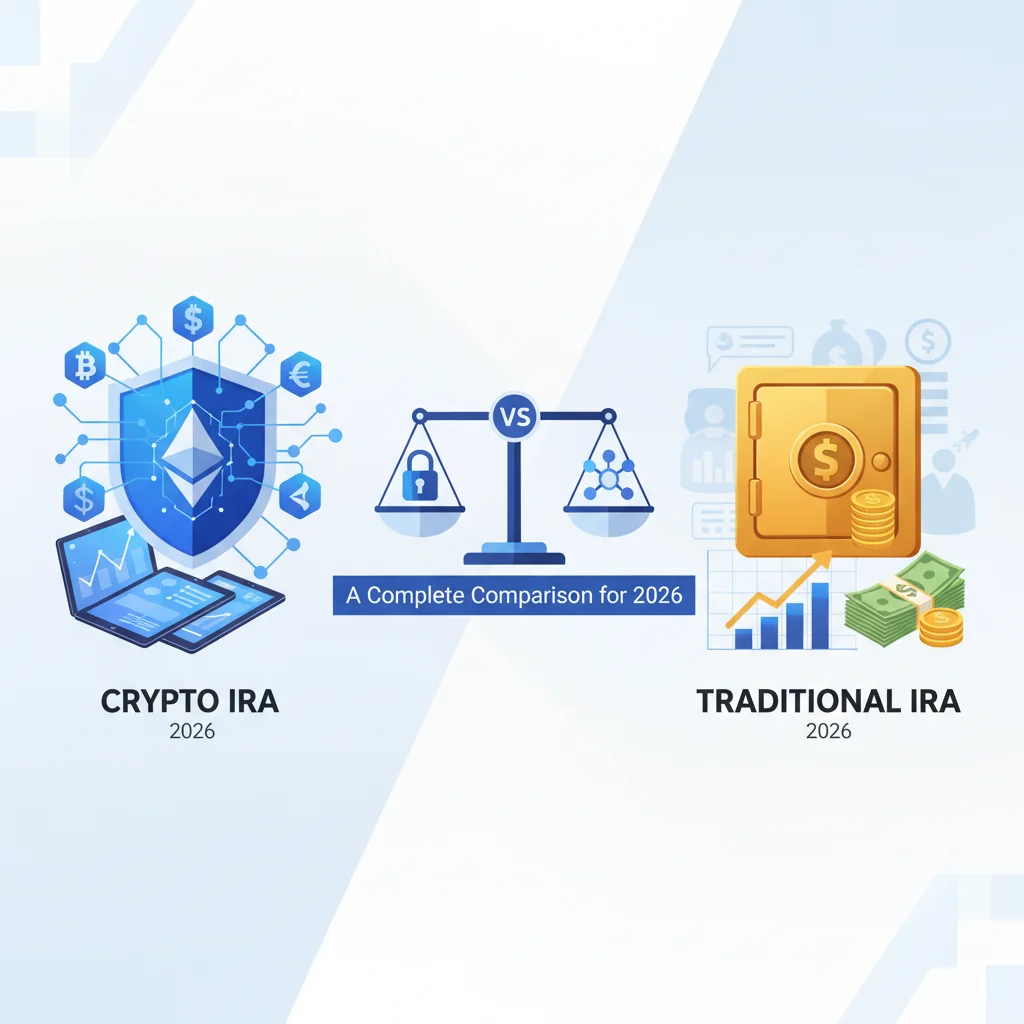
The world of retirement planning is constantly evolving, and with the emergence of digital assets, investors are now faced with more choices than ever before. For decades, Traditional IRAs have been a cornerstone of retirement savings, offering tax-deferred growth and a familiar investment landscape. However, the rise of cryptocurrencies has introduced a new contender: Crypto IRAs, which allow investors to hold digital assets like Bitcoin and Ethereum within a tax-advantaged retirement account. This innovation presents both exciting opportunities and unique challenges. As we look towards 2026, understanding the fundamental differences, benefits, risks, and regulatory landscape of Crypto IRAs versus Traditional IRAs is crucial for making informed decisions about your financial future. This comprehensive guide will break down everything you need to know to navigate these options effectively.
Crypto IRAs vs. Traditional IRAs Definition: Crypto IRAs are self-directed Individual Retirement Accounts that allow investors to hold cryptocurrencies as assets, while Traditional IRAs are tax-deferred retirement accounts primarily holding conventional assets like stocks, bonds, and mutual funds.
Understanding Traditional IRAs
Traditional Individual Retirement Accounts (IRAs) have been a staple of retirement planning for over 50 years, providing a powerful tool for individuals to save for their golden years with significant tax advantages. These accounts are designed to encourage long-term savings by offering tax deductions on contributions and tax-deferred growth on investments. Understanding their core mechanics is essential before comparing them to their digital counterparts.
How Traditional IRAs Work
A Traditional IRA functions as a personal savings plan that allows your investments to grow without being taxed until retirement. Contributions to a Traditional IRA may be tax-deductible in the year they are made, depending on your income level and whether you or your spouse are covered by a retirement plan at work. For instance, if you contribute $7,000 to a Traditional IRA and qualify for the deduction, your taxable income for that year could be reduced by up to $7,000 if fully deductible. This immediate tax benefit can be substantial, especially for those in higher tax brackets.
The investments held within a Traditional IRA — such as stocks, bonds, mutual funds, and exchange-traded funds (ETFs) — grow tax-deferred. This means you don't pay capital gains tax or income tax on dividends and interest until you withdraw the money in retirement. This compounding effect over decades can significantly boost your savings. Withdrawals in retirement are taxed as ordinary income. However, since many individuals are in a lower tax bracket during retirement than during their peak earning years, this can often result in an overall tax saving. The IRS sets annual contribution limits, which for 2025 are a maximum of $7,000 for those under 50 and $8,000 for those 50 and older. These limits are subject to change annually.
Key Benefits and Limitations of Traditional IRAs
The primary benefit of a Traditional IRA is its tax-deferred growth and potential for tax-deductible contributions. This allows your money to grow faster because you're not paying taxes on gains year after year. It's particularly advantageous for individuals who expect to be in a lower tax bracket in retirement than during their peak earning years. The flexibility in investment options is another strong point; most brokerages offer a wide array of traditional securities, allowing for diversified portfolios. Furthermore, you can contribute to a Traditional IRA even if you have a 401(k) or other employer-sponsored plan, though the deductibility of contributions might be phased out based on income.
However, Traditional IRAs also come with limitations. The main drawback is that withdrawals in retirement are taxed as ordinary income, meaning you'll eventually pay taxes on all your accumulated earnings. There are also rules regarding Required Minimum Distributions (RMDs), which mandate that you start withdrawing money from your account once you reach a certain age. For those turning 73 after December 31, 2022, the RMD age is 73. The RMD age will increase to 75 for those who attain age 73 after December 31, 2032 (i.e., individuals born in 1960 or later). Failing to take RMDs can result in steep penalties. Early withdrawals before age 59½ are generally subject to a 10% penalty in addition to ordinary income tax, with some exceptions. The investment options, while broad, are typically limited to conventional securities and do not directly include alternative assets like physical real estate or, crucially, cryptocurrencies.
Exploring Crypto IRAs
Crypto IRAs, often structured as Self-Directed IRAs (SDIRAs), represent a modern evolution in retirement planning, allowing investors to diversify their portfolios with digital assets. While the underlying tax structure is similar to a Traditional IRA (tax-deferred growth), the assets held within are vastly different. This section delves into how Crypto IRAs operate and their unique advantages and disadvantages.
How Crypto IRAs Work
A Crypto IRA is a specific type of Self-Directed IRA that permits the holding of alternative assets, including cryptocurrencies. Unlike a standard Traditional IRA offered by a typical brokerage, a Crypto IRA requires a specialized custodian that is equipped to handle and secure digital assets. The process generally involves setting up an SDIRA with a qualified custodian, who then facilitates the purchase and secure storage of cryptocurrencies. The investor maintains direct control over investment decisions, choosing which cryptocurrencies to buy, sell, or hold.
The tax treatment for a Crypto IRA mirrors that of a Traditional IRA: contributions may be tax-deductible (depending on income and other retirement plans), and all capital gains and earnings grow tax-deferred. You won't pay taxes on your crypto gains until you make withdrawals in retirement. This tax-deferred growth is a significant advantage, as it allows your cryptocurrency investments to compound without being reduced by annual capital gains taxes, which can be particularly impactful given the volatile nature and potential for rapid appreciation in the crypto market. When you eventually take distributions in retirement, these withdrawals are taxed as ordinary income.
Benefits and Risks of Investing in Crypto IRAs
The primary benefit of a Crypto IRA is the ability to gain exposure to the potentially high growth of the cryptocurrency market within a tax-advantaged retirement account. This allows investors to diversify beyond traditional stocks and bonds, potentially enhancing returns. For example, Bitcoin's average annual return over the last decade has significantly outpaced traditional asset classes. However, it is crucial to understand that such returns come with extreme volatility, the potential for total loss, and that past performance is not indicative of future results. These investments carry commensurate, often extreme, risk. The tax-deferred growth means that any substantial gains from crypto investments are not immediately subject to capital gains taxes, allowing more capital to remain invested and compound. This can be especially appealing for long-term holders (HODLers) of cryptocurrencies.
However, Crypto IRAs come with significant risks. It is crucial to understand that cryptocurrency investments are highly speculative and carry a significant risk of capital loss, particularly when allocating retirement funds. Past performance is not indicative of future results, and the extreme volatility of the crypto market means prices can fluctuate wildly, leading to substantial gains or losses in short periods. While cryptocurrency adoption has grown, many crypto holders have experienced significant volatility. This volatility means that while the upside potential is high, the risk of losing a significant portion of your retirement savings is also elevated. Due to their speculative nature and extreme volatility, Crypto IRAs are generally not recommended for the average retail investor's primary retirement savings. They are typically suited for a small portion of a highly diversified portfolio, and only for investors with a high-risk tolerance who understand the potential for significant capital loss. This is not personalized advice. Security is another concern; while custodians employ robust security measures, the digital nature of these assets makes them targets for hacks and scams. Furthermore, the regulatory landscape for cryptocurrencies is still evolving, which introduces uncertainty and potential future changes that could impact their value or accessibility. The fees associated with Crypto IRAs, including setup, transaction, and storage fees, can also be higher than those for traditional IRAs. Investors should carefully consider their risk tolerance and financial situation before investing in Crypto IRAs.
Key Differences: Crypto IRAs vs. Traditional IRAs
While both Crypto IRAs and Traditional IRAs serve the same fundamental purpose — saving for retirement with tax advantages — their core differences lie in the types of assets they hold, their associated risks, and the operational aspects of managing them. Understanding these distinctions is crucial for investors weighing their options.
Asset Classes and Investment Options
The most significant divergence between Crypto IRAs and Traditional IRAs is the asset classes they permit. Traditional IRAs are designed for conventional financial instruments. These typically include:
- Stocks: Individual company shares.
- Bonds: Debt securities issued by governments or corporations.
- Mutual Funds: Professionally managed portfolios of stocks, bonds, or other investments.
- Exchange-Traded Funds (ETFs): Funds that track an index, sector, commodity, or other asset, but can be bought or sold on a stock exchange like a regular stock.
- Certificates of Deposit (CDs) and Money Market Accounts: Low-risk, low-return savings vehicles.
Crypto IRAs, on the other hand, are specifically structured to hold digital assets. This includes a range of cryptocurrencies and related digital tokens:
- Major Cryptocurrencies: Bitcoin (BTC), Ethereum (ETH), Ripple (XRP), Litecoin (LTC), etc.
- Altcoins: A vast array of other cryptocurrencies beyond Bitcoin, offering diverse functionalities and market caps.
- Stablecoins: Cryptocurrencies pegged to fiat currencies, though their inclusion in IRAs may vary by custodian and regulatory interpretation.
- NFTs (Non-Fungible Tokens): While technically possible in some SDIRAs, the regulatory and custody complexities make them less common for retirement accounts.
This fundamental difference means that Traditional IRAs offer exposure to established, regulated markets, while Crypto IRAs provide access to a newer, often more volatile, and less regulated digital asset market.
Tax Implications and Contribution Rules
Both Crypto IRAs and Traditional IRAs share the same underlying tax framework as defined by the IRS for Traditional IRAs. This means:
- Tax-Deductible Contributions: Contributions may be tax-deductible in the year they are made, depending on your income and participation in employer-sponsored retirement plans. For 2025, the maximum contribution is $7,000 ($8,000 if age 50 or older).
- Tax-Deferred Growth: Investments grow tax-free until withdrawal. You don't pay annual capital gains or income tax on dividends/interest within the account.
- Taxable Withdrawals: All qualified withdrawals in retirement are taxed as ordinary income.
- Required Minimum Distributions (RMDs): Both account types are subject to RMDs starting at age 73 (for those turning 73 after December 31, 2022).
- Early Withdrawal Penalties: Withdrawals before age 59½ are generally subject to a 10% penalty in addition to ordinary income tax, with certain exceptions.
The key distinction here isn't in the rules themselves, but in their impact. For Crypto IRAs, the tax-deferred growth is particularly powerful because cryptocurrency gains can be substantial and rapid. Without a Crypto IRA, selling highly appreciated crypto would trigger immediate capital gains taxes. Within the IRA, these gains can compound without tax drag for decades. Conversely, if crypto investments perform poorly, the tax-deferred losses are also contained within the account, potentially reducing the overall value of your retirement savings without immediate tax relief.
Risk Profiles and Volatility
The risk profiles of Crypto IRAs and Traditional IRAs are vastly different, primarily due to the nature of their underlying assets.
Traditional IRAs generally carry a moderate to low-risk profile, depending on the specific asset allocation. While individual stocks can be volatile, a diversified portfolio of stocks, bonds, and mutual funds tends to be less volatile than a portfolio solely composed of cryptocurrencies. Historical data shows that traditional markets, while subject to downturns, often recover over long periods. For example, the S&P 500 has historically averaged returns of around 10% annually over the long term, with periods of significant drawdowns but also recovery. The risks include market downturns, inflation, and interest rate changes.
Crypto IRAs inherently carry a high-risk profile. Cryptocurrencies are known for their extreme volatility. It's not uncommon for major cryptocurrencies to experience price swings of 10-20% in a single day, or 50% or more over weeks or months. This high volatility means that while there's potential for exponential gains, there's also a significant risk of substantial losses. Other risks unique to crypto include:
- Regulatory Uncertainty: The lack of clear, comprehensive regulation globally introduces risks of sudden policy changes that could impact asset values.
- Technological Risks: Vulnerabilities in blockchain technology, smart contracts, or exchange platforms can lead to hacks and loss of assets.
- Liquidity Risks: Some smaller altcoins may have limited liquidity, making it difficult to buy or sell large quantities without impacting prices.
- Custody Risks: While reputable custodians mitigate this, holding digital assets with a third party introduces counterparty risk.
A 2024 survey by Gallup found that while 16% of U.S. adults reported owning cryptocurrency, many approach it with caution due to its volatile nature. Financial advisors often recommend that any allocation to highly volatile assets like crypto should be a small percentage of a well-diversified portfolio, typically no more than 5-10%, especially within a retirement account.
Custody and Management
The operational aspects of custody and management also differ significantly.
For Traditional IRAs, custody is straightforward. Most major financial institutions (brokerage firms, banks, mutual fund companies) serve as custodians. They handle all aspects of asset holding, record-keeping, and regulatory compliance. Investors typically manage their accounts through online platforms, making trades and monitoring performance with relative ease. The fees are generally competitive, often including commission-free trading for many ETFs and stocks.
For Crypto IRAs, the custody process is more specialized and complex. Because traditional brokerages generally do not hold cryptocurrencies directly, investors must use a specialized Self-Directed IRA custodian. These custodians are equipped to handle alternative assets and partner with crypto exchanges or dedicated crypto custodians to securely store the digital assets. This often involves:
- Cold Storage: Storing cryptocurrencies offline in hardware wallets to protect against online hacks.
- Multi-Signature Wallets: Requiring multiple keys to authorize transactions, adding an extra layer of security.
- Insurance: Some custodians offer insurance against theft or loss, though coverage limits and types can vary.
The management of a Crypto IRA typically involves higher fees compared to Traditional IRAs. These can include:
- Setup Fees: One-time fees to establish the SDIRA.
- Annual Maintenance Fees: Recurring fees for account administration.
- Transaction Fees: Fees for buying and selling cryptocurrencies.
- Storage/Custody Fees: Fees for the secure holding of digital assets, which can sometimes be a percentage of the assets under management.
These additional costs can eat into returns, especially for smaller portfolios, making it crucial to compare fee structures across different providers.
| Feature | Traditional IRA | Crypto IRA (Self-Directed IRA) |
|---|---|---|
| Primary Asset Classes | Stocks, bonds, mutual funds, ETFs, CDs | Cryptocurrencies (Bitcoin, Ethereum, altcoins) |
| Tax Treatment | Tax-deductible contributions, tax-deferred growth, taxable withdrawals | Tax-deductible contributions, tax-deferred growth, taxable withdrawals |
| Contribution Limits | $7,000 ($8,000 if 50+) for 2025 | Same as Traditional IRA |
| Risk Profile | Moderate to low (depending on allocation) | High (due to crypto volatility, regulatory uncertainty) |
| Custody | Standard brokerage firms, banks | Specialized Self-Directed IRA custodians |
| Management Complexity | Low to moderate | Moderate to high (requires specialized custodian, understanding of crypto) |
| Fees | Generally lower (trading commissions, expense ratios) | Generally higher (setup, annual, transaction, storage fees) |
| Liquidity | High for most assets | High for major cryptos, lower for altcoins |
| Regulatory Status | Highly regulated | Evolving, less comprehensive regulation |
Making the Right Choice for Your Retirement
Deciding between a Crypto IRA and a Traditional IRA, or even combining elements of both, requires careful consideration of your financial goals, risk tolerance, and investment horizon. There's no one-size-fits-all answer, and the optimal strategy will vary greatly from person to person.
Assessing Your Risk Tolerance and Investment Goals
Before committing to either type of IRA, it's paramount to conduct an honest assessment of your risk tolerance.
- High Risk Tolerance: If you are comfortable with significant market fluctuations, have a long investment horizon (many years until retirement), and are prepared for the possibility of substantial losses in pursuit of higher returns, a Crypto IRA might be an appealing option for a portion of your portfolio. You understand that the potential for exponential growth comes with commensurate risk.
- Moderate Risk Tolerance: For those who seek growth but prefer a more stable path, a Traditional IRA with a diversified portfolio of stocks and bonds is typically more suitable. You might consider a small, speculative allocation to crypto outside your primary retirement accounts, or through a very small percentage within a Crypto IRA.
- Low Risk Tolerance: If capital preservation is your top priority and market volatility causes you significant stress, a Traditional IRA heavily weighted towards conservative investments like bonds, CDs, and stable mutual funds is likely the best fit. Crypto IRAs would generally be ill-advised.
Your investment goals also play a crucial role. Are you aiming for aggressive growth, capital preservation, or a balanced approach? For aggressive growth, especially if you believe in the long-term potential of digital assets, a Crypto IRA can be a powerful tool. For stable, consistent growth over decades, a Traditional IRA is a proven vehicle.
Diversification Strategies
Regardless of your primary IRA choice, diversification remains a cornerstone of sound investment strategy.
- Within a Traditional IRA: Diversification involves spreading your investments across different asset classes (stocks, bonds, real estate investment trusts), industries, geographies, and company sizes. This helps mitigate risk by ensuring that a downturn in one area doesn't devastate your entire portfolio. For example, a common strategy is a mix of large-cap U.S. stocks, international stocks, and investment-grade bonds.
- Within a Crypto IRA: Diversification means investing in a variety of cryptocurrencies, not just one or two. This could include a mix of established large-cap coins (like Bitcoin and Ethereum), mid-cap altcoins with strong use cases, and potentially a small allocation to emerging projects. However, it's important to recognize that even a diversified crypto portfolio is still highly correlated and subject to overall market sentiment. True diversification often means combining crypto assets with traditional assets.
Many financial experts, including those cited by the Financial Industry Regulatory Authority (FINRA) in 2023, recommend that investors limit their exposure to highly volatile assets like cryptocurrencies to a small percentage (e.g., 1-5% or 5-10%) of their overall portfolio. This "satellite" allocation allows for participation in potential high growth without jeopardizing the core retirement savings.
Combining Crypto and Traditional IRA Strategies
For many investors, the most prudent approach might be to combine both Crypto and Traditional IRA strategies. This hybrid approach allows you to leverage the stability and proven growth of traditional assets while gaining exposure to the potential upside of cryptocurrencies.
Here’s how this might look:
Establish a Core Traditional IRA: Allocate the majority of your retirement savings (e.g., 80-95%) to a well-diversified Traditional IRA. This provides a stable foundation with predictable growth potential and lower volatility. This core portfolio would consist of a mix of stocks, bonds, and perhaps real estate ETFs, aligned with your long-term goals.
Create a Satellite Crypto IRA: Allocate a smaller, speculative portion of your retirement savings (e.g., 5-20%) to a Crypto IRA. This allows you to invest in digital assets with tax-deferred growth. This portion should be considered "risk capital" – money you can afford to lose without derailing your overall retirement plan.
Regular Rebalancing: Periodically review your overall asset allocation. If your crypto investments perform exceptionally well and grow to a larger percentage than intended, you might consider rebalancing by selling some crypto (within the IRA, without tax implications) and reallocating to traditional assets, or vice-versa if crypto underperforms.
This combined strategy offers the best of both worlds: the security and long-term reliability of traditional investments, coupled with the potential for outsized returns from the innovative cryptocurrency market, all while benefiting from tax advantages. For instance, a 40-year-old investor might have a Traditional IRA heavily invested in index funds, while simultaneously contributing a smaller amount to a Crypto IRA focused on Bitcoin and Ethereum. This allows them to participate in the digital economy's growth without putting their entire retirement at risk.
Regulatory Landscape and Future Outlook
The regulatory environment surrounding cryptocurrencies is a critical factor for investors, particularly when considering long-term retirement savings. As we approach 2026, the landscape is still evolving, but key trends and potential changes could significantly impact Crypto IRAs.
Current Regulations and Potential Changes
Currently, the Internal Revenue Service (IRS) classifies cryptocurrencies as property for tax purposes, not currency. This classification dictates how gains and losses are treated, and it's the foundation upon which Crypto IRAs operate under existing self-directed IRA rules. However, the broader regulatory framework is fragmented and often unclear.
In the United States, various government bodies have asserted jurisdiction over different aspects of crypto:
- Securities and Exchange Commission (SEC): Views many cryptocurrencies as unregistered securities, particularly initial coin offerings (ICOs). The SEC has been active in enforcement actions against crypto projects and exchanges. The approval of spot Bitcoin ETFs in early 2024 marked a significant step towards mainstream acceptance and regulatory clarity for Bitcoin as an investment product.
- Commodity Futures Trading Commission (CFTC): Considers Bitcoin and Ethereum to be commodities and regulates their derivatives markets.
- Treasury Department / FinCEN: Focuses on anti-money laundering (AML) and combating the financing of terrorism (CFT) aspects of crypto transactions.
Potential Changes: As we move towards 2026, several regulatory shifts could occur:
- Clearer Classification: There's ongoing debate in Congress about creating a clearer legal framework for digital assets, potentially distinguishing between securities, commodities, and currencies. This could lead to more tailored regulations for Crypto IRAs.
- Increased Oversight: Expect increased scrutiny on crypto exchanges and custodians regarding consumer protection, cybersecurity, and financial stability.
- Global Harmonization: International efforts to standardize crypto regulations could influence U.S. policy, aiming for a more consistent global approach to digital assets.
- Tax Reporting: The IRS may introduce more stringent reporting requirements for crypto transactions, though the tax-deferred nature of IRAs would shield investors from immediate tax implications within the account.
These potential changes could bring both benefits (e.g., increased investor confidence, more institutional adoption) and challenges (e.g., new compliance burdens, restrictions on certain assets).
The Role of Custodians and Compliance
For Crypto IRAs, the role of the custodian is paramount. Unlike traditional IRAs where custodianship is largely administrative, Crypto IRA custodians bear significant responsibility for the secure storage and regulatory compliance of digital assets.
- Secure Storage: Custodians must employ state-of-the-art security measures, including cold storage, multi-signature wallets, and robust cybersecurity protocols, to protect assets from theft or loss.
- Regulatory Compliance: They must ensure that all transactions and holdings comply with IRS rules for IRAs, as well as any evolving cryptocurrency-specific regulations. This includes proper record-keeping and reporting.
- Due Diligence: Reputable custodians perform due diligence on the cryptocurrencies they offer, ensuring they are not prohibited investments (e.g., collectibles, which are generally not allowed in IRAs) and meet certain liquidity and security standards.
The compliance burden on Crypto IRA custodians is likely to increase as regulations mature. Investors should carefully vet their chosen custodian, looking for:
- Longevity and Reputation: How long have they been in business? What are their reviews and track record?
- Security Measures: What specific technologies and protocols do they use for asset protection?
- Insurance: Do they offer insurance against theft or hacking, and what are the coverage limits?
- Fee Transparency: Are all fees clearly disclosed and competitive?
- Customer Support: Can they provide adequate support for complex crypto-related inquiries?
As the industry matures, we can expect to see more robust and standardized practices among custodians, but investor vigilance will remain crucial. The choice of custodian can significantly impact the safety and compliance of your Crypto IRA.
Frequently Asked Questions
What is the main difference between a Crypto IRA and a Traditional IRA?
The main difference lies in the types of assets they hold: a Traditional IRA invests in conventional assets like stocks and bonds, while a Crypto IRA (a type of Self-Directed IRA) allows you to invest in cryptocurrencies within a tax-advantaged retirement account. Both share similar tax benefits, such as tax-deferred growth.
Are Crypto IRA contributions tax-deductible?
Yes, contributions to a Crypto IRA, which functions as a Traditional Self-Directed IRA, may be tax-deductible in the year they are made, depending on your income level and whether you or your spouse are covered by a retirement plan at work. The rules for deductibility are the same as for a standard Traditional IRA.
What are the risks of investing in a Crypto IRA?
The primary risks of a Crypto IRA include the extreme volatility of cryptocurrency prices, which can lead to significant losses, regulatory uncertainty in the evolving crypto market, and potential security vulnerabilities despite custodian efforts. Fees associated with Crypto IRAs are also generally higher than those for Traditional IRAs. Due to their speculative nature, Crypto IRAs are generally not recommended for primary retirement savings but may suit a small, diversified portion for high-risk tolerance investors.
Can I hold both a Traditional IRA and a Crypto IRA?
Yes, you can hold both a Traditional IRA and a Crypto IRA. Many investors choose a hybrid strategy, allocating the majority of their retirement savings to a diversified Traditional IRA for stability and a smaller, speculative portion to a Crypto IRA for potential high growth.
How are Crypto IRA withdrawals taxed in retirement?
Qualified withdrawals from a Crypto IRA in retirement are taxed as ordinary income, just like withdrawals from a Traditional IRA. Any gains from your cryptocurrency investments held within the IRA grow tax-deferred until you make these withdrawals.
What are the annual contribution limits for Crypto IRAs?
The annual contribution limits for Crypto IRAs are the same as for Traditional IRAs. For 2025, this limit is $7,000 for individuals under age 50, and $8,000 for those age 50 and older. These limits are subject to change by the IRS annually.
Do Crypto IRAs have Required Minimum Distributions (RMDs)?
Yes, Crypto IRAs are subject to the same Required Minimum Distribution (RMD) rules as Traditional IRAs. For those turning 73 after December 31, 2022, you must begin taking distributions from your Crypto IRA once you reach age 73. These withdrawals will be taxed as ordinary income.
Key Takeaways
Asset Class Distinction: Traditional IRAs focus on conventional assets (stocks, bonds), while Crypto IRAs specialize in digital assets (cryptocurrencies).
Shared Tax Benefits: Both IRA types offer tax-deductible contributions and tax-deferred growth, with withdrawals taxed as ordinary income in retirement.
Risk vs. Reward: Crypto IRAs carry significantly higher risk and volatility but offer potential for exponential returns, contrasting with the more moderate, stable growth of Traditional IRAs. Crypto IRAs are generally for a small, speculative portion of a portfolio for high-risk tolerance investors.
Specialized Custody: Crypto IRAs require specialized Self-Directed IRA custodians for secure digital asset storage and compliance, often incurring higher fees.
Diversification is Key: A balanced approach often involves a core Traditional IRA for stability and a smaller, speculative Crypto IRA for growth potential.
Evolving Regulations: The cryptocurrency regulatory landscape is still maturing, posing both opportunities and uncertainties for Crypto IRA investors.
Informed Decision-Making: Your choice should align with your personal risk tolerance, investment goals, and understanding of the unique characteristics of each IRA type.
Conclusion
As the financial landscape continues to evolve, the decision between a Crypto IRA and a Traditional IRA for your retirement savings in 2026 is more nuanced than ever. While Traditional IRAs offer a time-tested, stable path to retirement with broad diversification across conventional assets, Crypto IRAs present an opportunity to tap into the high-growth potential of the digital asset market within a tax-advantaged structure. The key lies in understanding the distinct characteristics of each: the proven stability and lower fees of traditional investments versus the high volatility, specialized custody, and evolving regulatory environment of cryptocurrencies.
For many investors, a hybrid approach, combining a solid foundation in a Traditional IRA with a strategic, smaller allocation to a Crypto IRA, will offer the best balance of growth potential and risk management. This allows you to benefit from the tax-deferred compounding of both established and emerging asset classes. Ultimately, the right choice depends on your individual risk tolerance, investment horizon, and financial goals. Consulting with a qualified financial advisor can help you navigate these complex decisions and build a retirement portfolio that is resilient, diversified, and aligned with your personal financial aspirations.
Disclaimer: This article is for informational and educational purposes only and does not constitute financial, investment, or tax advice. Always consult a qualified financial advisor before making investment decisions.
The information provided in this article is for educational purposes only and does not constitute financial, investment, or legal advice. Always consult with a qualified financial advisor, tax professional, or legal counsel for personalized guidance tailored to your specific situation before making any financial decisions.
Comments
No comments yet. Be the first to comment!
More from Investing



Explore Related Guides
Expert reviews of Gold IRA companies, rollover guides, fees, and IRS rules.
Compare banking products, interest rates, and strategies to maximize your savings.
Master budgeting, debt management, taxes, and financial planning for your situation.