
The Anti-Budget: A Minimalist Approach to Managing Your Money
Editor's note: Names, images, and identifying details have been changed to protect the privacy of individuals featured in this article.
Patricia, a 62-year-old police officer in San Antonio, TX, recently found herself staring at her retirement account balance of $87,000, a modest $5,400 in her checking account, and a six-month emergency fund. Recently divorced and raising her 14-year-old son, she had always assumed Social Security would be enough to comfortably supplement her pension. However, after running the numbers, the reality hit: her current savings trajectory wasn't going to cut it. The idea of meticulously tracking every penny felt overwhelming and restrictive, a daunting task she simply didn't have the time or mental energy for. She needed a financial strategy that was effective but didn't demand constant vigilance. This is where the concept of an anti-budget, a minimalist approach to managing money, offers a refreshing alternative to traditional budgeting methods, providing financial clarity without the daily grind.
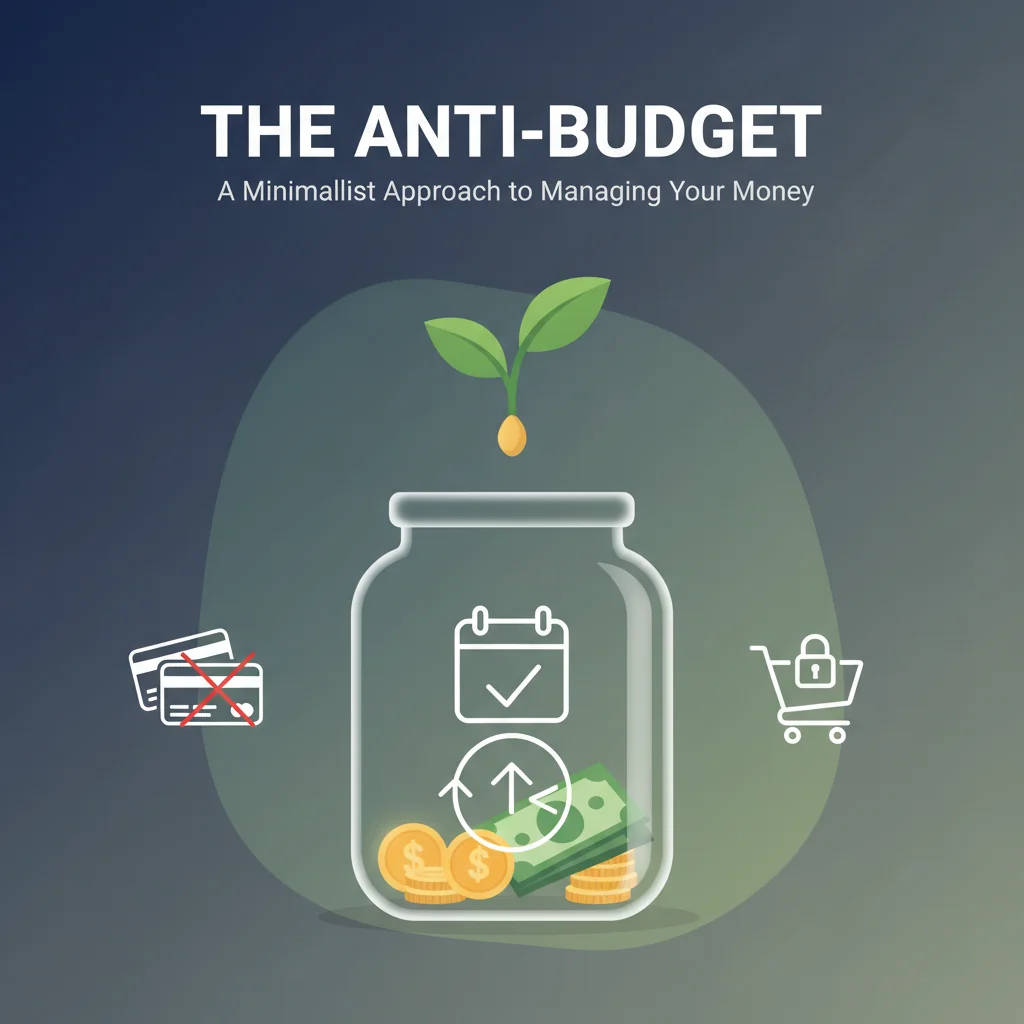
Anti-Budget Definition: An anti-budget is a simplified money management strategy that focuses on automating savings and debt payments first, then allowing for flexible spending with the remaining income, rather than meticulously tracking every expense.
Understanding the Anti-Budget Philosophy
Traditional budgeting often conjures images of spreadsheets, expense tracking apps, and the constant categorization of every dollar spent. While effective for some, this level of detail can be time-consuming, restrictive, and ultimately unsustainable for others. The anti-budget, sometimes called a "reverse budget" or "pay yourself first" method, flips this concept on its head. Instead of focusing on where every dollar goes, it prioritizes where your most important dollars should go: savings and debt repayment.
This approach is particularly appealing to individuals who find traditional budgeting too cumbersome or who feel stifled by strict spending limits. It acknowledges that financial discipline doesn't always have to come at the cost of flexibility. By automating your financial priorities, you essentially "budget" for your future first, then grant yourself freedom with the rest of your income. This can significantly reduce financial stress and decision fatigue, making money management feel less like a chore and more like an empowering habit.
The Core Principle: Pay Yourself First
At the heart of the anti-budget lies the powerful principle of "pay yourself first." This means that as soon as your paycheck hits your account, a predetermined portion is automatically transferred to your savings, investment accounts, and debt repayment funds before you spend on anything else. This proactive approach ensures that your long-term financial goals are consistently met, regardless of your day-to-day spending habits. For someone like Patricia, who needs to boost her retirement savings, this automation is a game-changer. Instead of hoping she has money left over at the end of the month, she guarantees that her future self is taken care of from the outset.
The beauty of this method is its simplicity. Once these automatic transfers are set up, they run in the background, requiring minimal ongoing effort. You're not constantly checking your budget categories or feeling guilty about a spontaneous purchase. The money allocated for your future is already secured. This psychological shift from restriction to freedom is often what makes the anti-budget so sustainable for many.
Why Traditional Budgets Fail for Many
While traditional budgeting methods like the 50/30/20 rule or zero-based budgeting are highly effective for some, they often fall short for others. The primary reasons for failure often revolve around complexity, time commitment, and psychological burden. Tracking every single expense, from a morning coffee to a monthly utility bill, can feel like a part-time job. For busy professionals, parents, or anyone with a demanding schedule, this level of detail is simply not feasible to maintain consistently.
Moreover, the restrictive nature of traditional budgets can lead to feelings of deprivation. Constantly saying "no" to small luxuries or spontaneous outings can make budgeting feel like a punishment rather than a tool for financial freedom. This often results in budget fatigue, where individuals eventually give up, feeling defeated and out of control. According to a 2023 survey by the National Endowment for Financial Education, 70% of Americans admit to having difficulty managing their money, and a significant portion cite the complexity and restrictiveness of traditional budgeting as a barrier. The anti-budget aims to circumvent these common pitfalls by simplifying the process and focusing on the most impactful financial actions.
How the Anti-Budget Works: Step-by-Step Implementation
Implementing an anti-budget is remarkably straightforward, making it accessible even for those new to personal finance. The process revolves around understanding your income, setting clear financial priorities, and then automating the execution of those priorities. It removes the guesswork and the daily grind associated with traditional budgeting, allowing you to focus on living your life while your money works for you.
The core idea is to allocate money to your savings and debt first, then live off the remainder without stringent tracking. This method leverages human psychology by making the "right" financial decisions automatic and effortless.
Step 1: Understand Your Net Income
The very first step in setting up an anti-budget is to have a clear understanding of your net income, also known as your take-home pay. This is the amount of money that actually lands in your bank account after taxes, insurance premiums, retirement contributions (if pre-tax), and other deductions have been withheld from your gross salary. It's crucial to use your net income because this is the actual money you have available to work with.
Gather your pay stubs or check your bank statements for the last few months to get an accurate average. If your income varies (e.g., you're a freelancer or work on commission), it's wise to calculate a conservative average or use your lowest expected income to ensure you don't overcommit your funds. Knowing this number is the foundation upon which your entire anti-budget will be built, as it dictates how much you can realistically allocate to your financial goals.
Step 2: Determine Your Financial Priorities
Once you know your net income, the next critical step is to identify and prioritize your financial goals. This isn't just about saving for a rainy day; it's about defining what financial security and freedom mean to you. Common priorities include:
- Emergency Fund: Building a safety net for unexpected expenses. Financial experts typically recommend 3-6 months' worth of essential living expenses.
- Debt Repayment: Accelerating payments on high-interest debt, such as credit cards or personal loans.
- Retirement Savings: Contributing to 401(k)s, IRAs, or other investment vehicles to secure your future. Patricia, for example, would focus heavily on this.
- Short-Term Savings Goals: Saving for a down payment on a house, a new car, a vacation, or your child's education.
Assign a percentage or a fixed dollar amount to each of these priorities. A popular guideline for the anti-budget is the 80/20 rule, where you save/invest 20% of your net income and spend the remaining 80%. However, this is a guideline, not a strict rule. You might start with 10% if 20% feels too aggressive, or aim for 30% if you have aggressive debt repayment goals. The key is to choose percentages that are both challenging and realistic for your current financial situation.
Step 3: Automate Savings and Debt Payments
This is the most crucial step and the cornerstone of the anti-budget strategy. Set up automatic transfers from your checking account to your savings, investment accounts, and debt payments. These transfers should ideally occur on or shortly after your payday.
Here's how to automate:
- Savings Accounts: Link your checking account to a high-yield savings account and schedule recurring transfers. Consider separate accounts for different goals (e.g., emergency fund, vacation fund).
- Investment Accounts: Set up automatic contributions to your 401(k) (often done through payroll deduction), IRA, or brokerage account.
- Debt Payments: If you're paying more than the minimum on a loan or credit card, set up an automatic transfer for the extra amount.
By automating these transfers, you remove the need for willpower and decision-making each month. The money goes where it needs to go before you even have a chance to spend it. This proactive approach ensures consistency and significantly increases your likelihood of reaching your financial goals. According to a 2022 study by Bank of America, individuals who automate their savings are twice as likely to meet their financial goals compared to those who don't.
Step 4: Spend Freely (Within Reason)
Once your automated transfers are in place and your financial priorities are secured, the remaining money in your checking account is yours to spend as you wish. This is the "anti-budget" part of the anti-budget. You don't need to track every coffee, every meal out, or every shopping trip. As long as you stay within the bounds of your remaining funds, you're good.
This freedom is what makes the anti-budget so liberating. It reduces the mental load of managing money and allows for flexibility. However, "within reason" is key. If you consistently run out of money before your next payday, it's a sign that your initial allocation (Step 2) might be too aggressive, or your discretionary spending is still too high. In such cases, you might need to:
- Adjust allocations: Reduce the percentage going to savings/debt slightly.
- Review large discretionary expenses: Are there any significant non-essential purchases you can cut back on?
- Increase income: Explore opportunities for side hustles or salary negotiations.
The goal is to find a balance where you're consistently meeting your financial goals without feeling overly restricted in your daily life. This iterative process of setting, automating, and occasionally adjusting is what makes the anti-budget a sustainable long-term strategy.
Benefits and Drawbacks of the Anti-Budget
Like any financial strategy, the anti-budget has its strengths and weaknesses. Understanding these can help you determine if it's the right approach for your personal financial situation and personality. For individuals who have struggled with traditional budgeting, the benefits often outweigh the drawbacks, offering a pathway to financial stability without the typical frustrations.
The anti-budget is not a one-size-fits-all solution, but its minimalist nature makes it particularly attractive to those seeking simplicity and freedom in their financial lives.
Advantages of the Anti-Budget
The anti-budget offers several compelling benefits, particularly for those who find traditional budgeting methods cumbersome or restrictive. Its simplicity and focus on automation are often cited as its greatest strengths.
- Simplicity and Ease of Use: The primary advantage is its straightforward nature. Once the initial setup of automatic transfers is complete, there's minimal ongoing effort required. You don't need to categorize every transaction or track daily spending, freeing up significant time and mental energy. This ease makes it a sustainable method for busy individuals or those who are easily overwhelmed by detailed financial tracking.
- Reduced Financial Stress and Decision Fatigue: By automating your financial priorities, you eliminate the constant internal debate about whether you should save or spend. The "hard" decisions are made once, upfront, leaving you with guilt-free spending for the remainder of your income. This significantly reduces financial stress and the mental burden of managing money.
- Guaranteed Progress Towards Goals: Because savings and debt payments are prioritized and automated, you are consistently making progress towards your financial goals. This "pay yourself first" mentality ensures that your future is taken care of, even if your discretionary spending varies from month to month. It builds financial resilience by consistently funding your emergency fund, retirement, and other important objectives.
- Flexibility and Freedom: Unlike rigid traditional budgets, the anti-budget allows for more flexibility in your day-to-day spending. As long as your core financial obligations are met, you have the freedom to spend the rest of your money as you see fit. This can lead to a more enjoyable and less restrictive financial life, making it easier to stick with the strategy long-term.
- Ideal for Consistent Income Earners: This method works exceptionally well for individuals with a steady, predictable income, such as salaried employees. The consistent paycheck makes it easy to set up reliable automatic transfers, ensuring that the system runs smoothly without frequent adjustments.
Potential Drawbacks and When It Might Not Be Enough
While the anti-budget offers significant advantages, it's not without its limitations. Understanding these drawbacks is crucial for determining if this method aligns with your specific financial situation and goals.
- Less Detailed Spending Insight: The biggest drawback is the lack of granular detail regarding your spending habits. If you're consistently running out of money before your next paycheck, the anti-budget won't immediately tell you where that money went. You'll have to manually review your bank statements to identify areas for reduction, which defeats some of the "anti-tracking" purpose. For someone trying to pinpoint specific spending leaks, this can be a significant hurdle.
- Requires Strong Initial Discipline: While it reduces ongoing effort, the anti-budget demands strong initial discipline to set up the correct allocation percentages. Overestimating your discretionary spending or underestimating your fixed expenses can lead to problems. It also requires the discipline to not dip into your automated savings or investment accounts once they've been funded.
- Challenging for Irregular Income: Individuals with highly variable incomes (e.g., freelancers, commission-based sales, gig workers) might find the anti-budget more challenging to implement. Setting consistent automatic transfers becomes difficult when your net income fluctuates significantly each month. It might require more frequent adjustments or adopting a more conservative "lowest income" approach, which could leave more money unallocated in high-income months.
- Not Ideal for Deep Dive into Spending Habits: If you're trying to drastically cut expenses, understand where every dollar is going, or overcome significant overspending issues, the anti-budget might not provide enough insight. It's more about ensuring some money goes to savings/debt, rather than optimizing all spending. For a period of intense financial overhaul, a more detailed budget might be necessary.
- Potential for Lifestyle Creep: Without detailed tracking, there's a higher risk of lifestyle creep, where your spending increases proportionally with your income. If you don't periodically review your overall spending or increase your automated savings as your income grows, you might miss opportunities to accelerate your financial goals.
| Feature | Anti-Budget (Minimalist) | Traditional Budget (Detailed) |
|---|---|---|
| Primary Focus | Automating savings/debt first, then flexible spending | Tracking all income and expenses, categorizing every dollar |
| Effort Required | Low (after initial setup) | High (ongoing tracking and adjustment) |
| Flexibility | High (with discretionary spending) | Low (strict adherence to categories) |
| Spending Insight | Low (general overview) | High (detailed breakdown of all expenses) |
| Best For | Consistent income, busy individuals, those prone to budget fatigue | Variable income, aggressive debt reduction, detailed financial analysis |
| Risk | Lifestyle creep, less insight into overspending | Budget fatigue, feelings of restriction |
Who Benefits Most from an Anti-Budget?
The anti-budget isn't for everyone, but it shines for specific financial personalities and situations. Its minimalist nature makes it a powerful tool for those who have struggled with more intricate financial planning methods. Understanding if you fit the profile can help you decide if this approach is your path to financial freedom.
For Patricia, the anti-budget offers a practical solution. She has a consistent income, a clear need to boost her retirement savings, and limited time for meticulous tracking. The idea of automating her savings and then having the freedom to manage her remaining expenses without guilt is highly appealing.
Consistent Income Earners
The anti-budget is particularly well-suited for individuals who receive a consistent, predictable income. This includes salaried employees, those with stable hourly wages, or retirees with fixed pension and Social Security payments. A steady income stream makes it easy to:
- Calculate a reliable net income: This is the foundation for setting accurate automatic transfer amounts.
- Set up consistent automated transfers: Knowing exactly when and how much money will arrive allows for seamless scheduling of transfers to savings, investments, and debt.
- Predict remaining discretionary funds: With a consistent income, you can more accurately gauge how much money you'll have left for flexible spending after your priorities are met.
For someone like Patricia, with her police officer salary, the consistency makes the anti-budget an ideal fit. She knows her take-home pay, allowing her to confidently set up her automated contributions without worrying about income fluctuations.
Individuals Prone to Budget Fatigue
Many people start traditional budgets with good intentions, only to abandon them after a few weeks or months due to budget fatigue. This often stems from the overwhelming nature of tracking every transaction, the feeling of constant restriction, or the guilt associated with "failing" to stick to a category.
The anti-budget directly addresses this by:
- Minimizing tracking: Once set up, there's no daily or weekly logging of expenses.
- Promoting guilt-free spending: The money left after automation is truly discretionary, removing the psychological burden of "should I buy this?"
- Focusing on progress, not perfection: The emphasis is on consistently hitting your savings and debt goals, rather than perfectly adhering to spending limits in every category.
If you've tried and failed at traditional budgeting multiple times, the anti-budget offers a refreshing, less demanding alternative that can help you finally achieve financial consistency.
Those Who Prioritize Simplicity Over Granular Detail
Some individuals simply prefer a minimalist approach to all aspects of their lives, including their finances. They value simplicity and efficiency over granular detail. For these individuals, the anti-budget resonates because it:
- Reduces complexity: It streamlines money management to its core elements.
- Frees up mental bandwidth: Less time spent on financial tracking means more time for other pursuits.
- Aligns with a "less is more" philosophy: It demonstrates that effective financial management doesn't require intricate systems.
If you're not interested in knowing precisely how much you spend on groceries versus dining out, but you are committed to saving for retirement and paying down debt, the anti-budget provides the perfect balance. It ensures your big financial rocks are in place without getting bogged down in the pebbles.
Enhancing Your Anti-Budget: Tools and Strategies
While the anti-budget is inherently simple, there are several tools and strategies you can employ to make it even more effective and robust. These enhancements can help you gain a little more insight without sacrificing the minimalist spirit of the anti-budget. They can also help you stay on track and make adjustments as your financial life evolves.
The goal is to leverage technology and smart financial habits to reinforce your anti-budget, ensuring your financial priorities remain met while still enjoying spending freedom.
Leveraging Technology for Automation
Technology is your best friend when it comes to the anti-budget. Modern banking and financial apps make automation incredibly easy and efficient.
- Online Banking & Automatic Transfers: Most banks allow you to set up recurring transfers between your checking and savings accounts, or even to accounts at different institutions. Schedule these to coincide with your paydays. For example, if Patricia gets paid bi-weekly, she can set up bi-weekly transfers to her retirement and emergency savings accounts.
- Investment Platform Automation: Brokerage firms and retirement plan providers (like those for 401(k)s or IRAs) offer automatic investment plans. You can set up recurring contributions directly from your bank account. This ensures you're consistently investing, benefiting from dollar-cost averaging (investing a fixed amount regularly, regardless of market fluctuations).
- Bill Pay Services: Automate all your fixed bills (rent/mortgage, utilities, loan payments, insurance) through your bank's bill pay service or directly with the service providers. This ensures you never miss a payment and avoid late fees.
- Budgeting Apps (Used Minimally): While the anti-budget avoids detailed tracking, some apps like Mint or Personal Capital can still be useful for a high-level overview. You can link all your accounts and quickly see your net worth, track your automated savings growth, and get alerts for unusual spending patterns without having to categorize every single transaction. This provides a "check-in" without the daily grind.
Periodic Financial Reviews
Even with an anti-budget, it's crucial to conduct periodic financial reviews. This doesn't mean daily tracking, but rather a monthly, quarterly, or semi-annual check-up to ensure your strategy is still aligned with your goals and current financial situation.
During a review, consider:
- Income Changes: Has your income increased or decreased? Adjust your automated savings percentages accordingly. If you get a raise, consider increasing your "pay yourself first" amount to avoid lifestyle creep.
- Goal Progress: Are you on track to meet your savings and debt repayment goals? If not, you might need to increase your automated transfers or temporarily cut back on discretionary spending.
- Spending Patterns (High Level): Briefly review your bank statements to ensure your discretionary spending isn't consistently exceeding your remaining funds. If you're frequently running low before payday, it's a sign to re-evaluate.
- Fixed Expenses: Are there any subscriptions you no longer use? Can you negotiate better rates on insurance or internet? This is a good time to trim the fat on your fixed costs.
- Emergency Fund Status: Is your emergency fund fully funded? If not, prioritize building it up.
These reviews are about strategic adjustments, not micro-management. They ensure your anti-budget remains effective and responsive to your evolving financial life.
The Role of a "Buffer" Account
Consider setting up a small buffer account or maintaining a slightly higher balance in your checking account than strictly necessary. This acts as a small cushion for unexpected minor expenses or slight overspending in a given month, preventing you from dipping into your emergency fund or going into overdraft.
For example, if your monthly expenses after automation are typically $3,000, you might aim to keep an extra $500-$1,000 in your checking account as a buffer. This provides peace of mind and prevents minor financial hiccups from derailing your anti-budget system. Patricia, with her $5,400 checking balance, already has a healthy buffer, which contributes to her financial stability.
Common Anti-Budget Scenarios and Solutions
The anti-budget is flexible, but real-life scenarios can sometimes throw a wrench into even the simplest financial plans. Understanding how to adapt the anti-budget to common challenges can help maintain its effectiveness and prevent financial stress. These practical solutions ensure that the minimalist approach remains robust in the face of life's complexities.
Whether it's an unexpected expense or a fluctuating income, the anti-budget can be tweaked to suit your needs without abandoning its core principles.
Dealing with Irregular Income
As mentioned, irregular income can be a challenge for the anti-budget. However, it's not insurmountable.
Solutions:
Conservative Baseline: Base your automated savings and fixed expenses on your lowest expected monthly income. Treat any income above this baseline as a bonus.
"Income Waterfall" Method: Create a hierarchy for your income when it arrives. For example:
Fund fixed expenses for the month.
Automate your priority savings/debt payments (e.g., 20% of the actual income received).
Allocate a portion to a "buffer" or "future expenses" fund to smooth out low-income months.
Spend the remainder.
Quarterly/Annual Review: For highly irregular income, a monthly review might be too frequent. Instead, review quarterly or annually, adjusting your automated transfers based on your average income over that period. This allows for larger, less frequent adjustments.
Build a Larger Emergency Fund: With irregular income, a more robust emergency fund (6-12 months of expenses) is even more critical to weather lean periods without touching your long-term savings.
Unexpected Expenses and Emergencies
Life happens, and unexpected expenses are inevitable. This is precisely why building an emergency fund is a core priority of the anti-budget.
Solutions:
- Tap Your Emergency Fund: This is what your emergency fund is for. Use it for true emergencies (e.g., medical bills, car repairs, job loss).
- Replenish Promptly: After using your emergency fund, make replenishing it your top financial priority. You might temporarily increase your automated transfers to it or reduce discretionary spending until it's back to your desired level.
- Review Insurance Coverage: Ensure you have adequate health, auto, and home insurance to mitigate the financial impact of major unexpected events. This can prevent small emergencies from becoming financial disasters.
When Your Discretionary Spending is Too High
If you find yourself consistently running out of money before your next payday, it's a clear sign that your discretionary spending is too high, or your initial "pay yourself first" percentage is too aggressive.
Solutions:
- Temporary Tracking: For one month, revert to a traditional budget to track all your spending. This will quickly reveal where your money is going and identify specific areas for reduction. Once you've identified the culprits, you can go back to your anti-budget.
- Adjust "Pay Yourself First" Percentage: If your essential fixed expenses consume a larger portion of your income than you initially thought, you might need to temporarily reduce the percentage you're saving or paying towards debt. The goal is sustainability.
- "No-Spend" Challenges: Implement a "no-spend" week or month to reset your spending habits and identify non-essential purchases you can cut back on.
- The "Envelope System" for Discretionary Spending: If you struggle with overspending in certain categories, consider using cash for those areas. Withdraw a set amount for groceries, entertainment, or personal care at the beginning of the month, and when it's gone, it's gone. This provides a physical limit without tracking every digital transaction.
By proactively addressing these common scenarios, you can ensure your anti-budget remains a powerful and sustainable tool for managing your money effectively.
Frequently Asked Questions
What is an anti-budget and how does it differ from traditional budgeting?
An anti-budget, also known as a reverse budget, is a money management strategy where you prioritize automating your savings and debt payments first, typically 20% of your income, and then spend the remaining money freely without detailed tracking. Traditional budgeting, conversely, involves meticulously tracking and categorizing every expense to stay within predefined limits for various spending categories.
Is the anti-budget suitable for everyone?
The anti-budget is best suited for individuals with a consistent income who find traditional budgeting restrictive or overwhelming. It's ideal for those who want simplicity and flexibility in their spending, while still ensuring their financial goals are met. It may be less suitable for those with highly irregular incomes or those who need to deeply analyze every spending habit to overcome significant financial challenges.
How much should I save with an anti-budget?
A common guideline for the anti-budget is to save and invest at least 20% of your net income. This includes contributions to your emergency fund, retirement accounts, and any accelerated debt payments. However, this is a starting point; you can adjust this percentage based on your financial goals, income, and current expenses.
What are the first steps to setting up an anti-budget?
The first steps involve understanding your net income, identifying your key financial priorities (e.g., emergency fund, debt, retirement), and then setting up automatic transfers to fund these priorities immediately after each payday. Once these automated transfers are in place, the remaining money in your checking account is available for flexible spending.
Can an anti-budget help me pay off debt faster?
Yes, an anti-budget can be very effective for debt repayment. By making debt payments (beyond the minimums) one of your automated financial priorities, you ensure that a consistent amount is applied to your debt each month, accelerating your payoff timeline. This "pay yourself first" approach ensures debt reduction isn't an afterthought.
What if I consistently run out of money before my next payday?
If you frequently run out of money, it indicates that either your "pay yourself first" percentage is too high for your current income and expenses, or your discretionary spending is still too high. You might need to temporarily track your spending for a month to identify specific areas to cut back, or slightly reduce your automated savings/debt payments until your income increases or expenses decrease.
How often should I review my anti-budget?
While the anti-budget minimizes daily tracking, periodic reviews are essential. It's recommended to review your financial situation monthly, quarterly, or at least semi-annually. These reviews should check for income changes, progress toward goals, and ensure your automated transfers are still appropriate for your current financial circumstances.
Key Takeaways
- Simplicity is Key: The anti-budget focuses on automating core financial priorities, reducing the mental burden and time commitment of traditional budgeting.
- Pay Yourself First: The cornerstone of the anti-budget is to automatically transfer funds to savings, investments, and debt repayment before any discretionary spending.
- Freedom with Remaining Funds: Once priorities are met, the anti-budget allows for flexible, guilt-free spending with the rest of your income.
- Ideal for Consistent Income: This method works best for individuals with predictable income streams who can reliably set up automated transfers.
- Periodic Reviews are Crucial: Even with automation, regular (monthly/quarterly) check-ups are necessary to ensure your anti-budget aligns with your evolving financial goals and income.
- Technology is Your Ally: Leverage online banking and investment platforms to easily set up and manage automatic transfers.
- Not a One-Size-Fits-All: While powerful, it may not provide enough granular detail for those needing to drastically cut spending or with highly variable incomes.
Conclusion
The anti-budget offers a refreshing, minimalist alternative to traditional money management for those who find detailed tracking overwhelming or unsustainable. By prioritizing and automating your savings and debt payments first, you effectively "pay yourself first," securing your financial future without the daily grind of categorizing every expense. This approach empowers individuals like Patricia to take control of their finances, reduce stress, and consistently work towards their long-term goals. For Patricia, implementing an anti-budget meant setting up automatic transfers to boost her retirement savings and contribute to her son's education fund. This simple, consistent action, rather than meticulous tracking, gave her peace of mind and a clear path forward.
If you've struggled with traditional budgeting methods or simply prefer a more streamlined approach, the anti-budget could be the financial strategy you've been searching for. It's about making smart, impactful financial decisions upfront, then enjoying the freedom that comes with knowing your future is taken care of. Take the first step today: understand your net income, define your financial priorities, and automate your contributions. Your future self will thank you. For more insights on building a robust financial plan, explore our resources on personal finance basics.
Disclaimer: This article is for informational and educational purposes only and does not constitute financial, investment, or tax advice. Always consult a qualified financial advisor before making investment decisions.
The information provided in this article is for educational purposes only and does not constitute financial, investment, or legal advice. Always consult with a qualified financial advisor, tax professional, or legal counsel for personalized guidance tailored to your specific situation before making any financial decisions.
Comments
No comments yet. Be the first to comment!
More from Personal Finance



Explore Related Guides
Expert reviews of Gold IRA companies, rollover guides, fees, and IRS rules.
Comprehensive investment strategies covering stocks, bonds, ETFs, crypto, and real estate.
Compare banking products, interest rates, and strategies to maximize your savings.